

Unit 18 · 40 min read
Capstone: Your Trading Operating Plan.
Combine strategy, risk, execution, psychology, review and OA rules into one usable document: markets, sessions, setups, risk per trade, daily stop, weekly review and an OA Funded rules checklist.
- Level
- Intermediate
- Revision
- mentor-2026-10
- Access
- Public
By the end, you can
- Write a complete operating plan with seven sections you can follow under pressure
- Define markets, sessions and setups as clear if-then rules
- Calculate position size from risk per trade and stop distance
- Set a personal daily stop and measure its distance from the OA Funded daily and maximum loss floors
- Build a rules checklist that matches the published OA Funded rulebook
- Set a weekly review routine and stress-test the plan against realistic scenarios
One document you can follow when it gets hard
Everything in this Academy comes together here. You have learned risk, setups, journaling, psychology and the OA Funded rules. Now you put them in one place, written in your own words, short enough to read before every session.
Why one document? Because under pressure you will not remember the third bullet on a note from two months ago. When you are two losses down or close to a target, you need a page that tells you exactly what to do. If the answer is not written down, your feelings will write it for you.
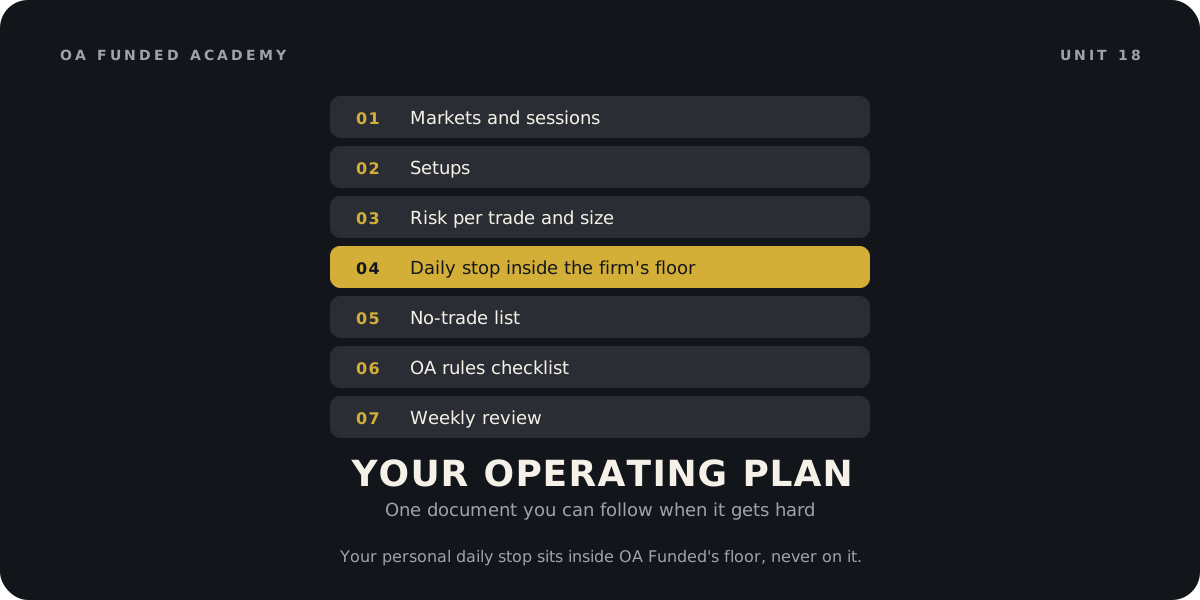
Your operating plan has seven sections: markets and sessions, setups, risk per trade, daily stop, your no-trade list, an OA Funded rules checklist, and a weekly review. The activities in this unit produce each section. By the end you will have a working draft.
One honest point before you start. A finished plan is evidence of preparation, not a promise of profit or of passing an evaluation. The plan's job is to make your decisions consistent so your results can tell you something. You then practise it, review it and improve it.
Sections 1 and 2: markets, sessions and setups
Start narrow. On OA Funded you trade FX and indices on TradeLocker. That does not mean you should watch all of them. Pick two to four instruments you understand and that move during hours you can actually be at the screen. A trader in London with a day job might choose EUR/USD and GBP/USD in the early London session. A trader in New York might pick one index and EUR/USD around the US open.
Write your sessions as clock times in your own time zone, plus the days you will trade. Include the times you will not trade, such as the last hour before you leave for work.
Then write each setup as an if-then rule. 'If the daily trend is up, and price pulls back to a marked support level on the 1-hour chart, and a bullish rejection candle closes, then I enter long on the next candle with a stop below the candle low and a target at the previous high.' Every word should be checkable. 'Looks strong' is not a rule. 'Closes above the prior candle high' is.
Limit yourself to one to three setups. Each one should come from testing or journaled evidence, not from a video you watched last night.
Section 3: risk per trade and position size
Pick a fixed risk per trade as a percentage of the account, then convert it to dollars. Most of this Academy uses 0.5% to 1% in examples because it leaves room for losing streaks. Write the dollar figure for your account size in the plan so you never calculate it in a hurry.
Position size comes from two numbers: the dollars you are willing to lose and the distance to your stop. You never choose lot size first and then find a stop that fits. You choose the stop where the setup is proven wrong, then size the position so that stop costs your fixed risk.
Worked example
Sizing a EUR/USD trade on a $25,000 account
Simulated $25,000 account. The plan says risk 0.5% per trade. The setup puts the stop 25 pips from entry. On EUR/USD one standard lot is worth about $10 per pip.
- Dollar risk: $25,000 x 0.005 = $125.
- Cost of the stop per standard lot: 25 pips x $10 = $250.
- Position size: $125 / $250 = 0.5 standard lots.
- Check: 0.5 lots x $10 per pip = $5 per pip. 25 pips x $5 = $125. The stop costs exactly the planned risk.
- If the stop needed 50 pips, the size would halve to 0.25 lots. The dollar risk stays at $125.
Takeaway: Risk stays fixed and size moves with the stop. Write the formula in your plan: lots = dollar risk / (stop in pips x pip value per lot).
Section 4: your daily stop sits inside the firm's floor
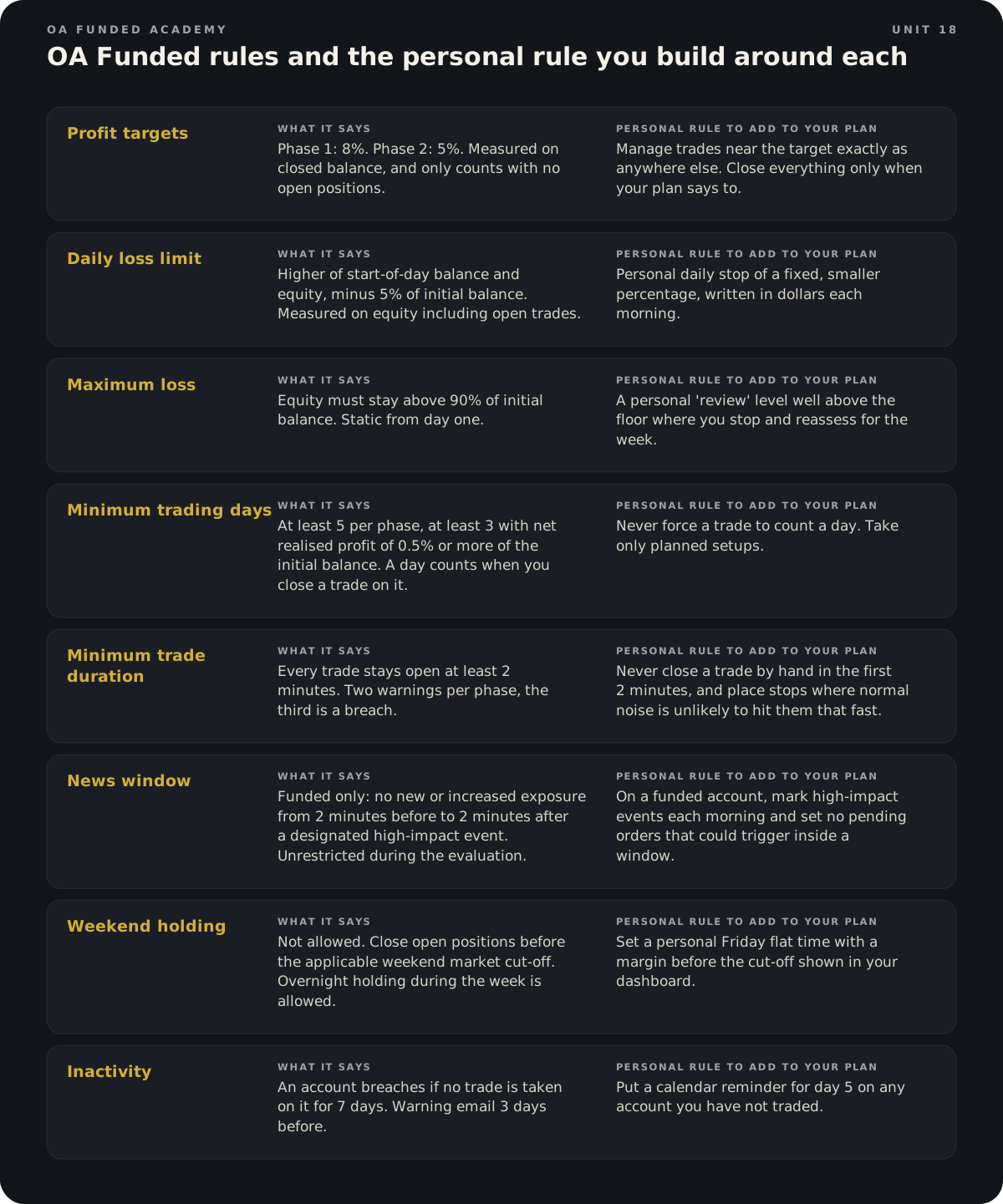
On OA Funded the daily loss limit works like this. At the start of each trading day, the higher of your balance and your equity is taken. Then 5% of your initial balance is subtracted. That is your floor for the day. If your equity, including open trades, falls below it, the account breaches. The trading day follows the trading platform's server day, and the exact cut-off time is shown in your dashboard.
There is also a maximum loss. Your equity, including open trades, must stay above 90% of your initial balance. The floor is fixed from day one and never moves up with your profits.
Both floors are measured on equity, including open trades. That means a trade that is losing but not closed still counts. Your personal daily stop should be well inside the firm's floor, not equal to it. If your personal stop is the firm's floor, one bad fill or one trade moving against you past your stop ends the account. A buffer is what lets you make a mistake and still trade tomorrow.
Worked example
Finding your floors and your buffer on a $25,000 account
Simulated $25,000 OA Funded account (initial balance $25,000). Yesterday ended with a closed balance of $25,400. At the start of today one trade is still open and losing, so equity is $25,250. The trader's personal daily stop is 1.5% of the initial balance.
- Start-of-day reference: the higher of balance ($25,400) and equity ($25,250) is $25,400.
- 5% of the initial balance: $25,000 x 0.05 = $1,250.
- Daily floor for today: $25,400 - $1,250 = $24,150 in equity.
- Maximum loss floor: 90% of $25,000 = $22,500 in equity. This never changes.
- Personal daily stop: 1.5% of $25,000 = $375. Measured from the $25,400 reference, the trader stops for the day if equity reaches $25,025.
- Buffer between the personal stop and the firm's daily floor: $25,025 - $24,150 = $875, which is seven trades of $125 risk.
Takeaway: Write three numbers at the top of every session: today's firm daily floor, the fixed maximum loss floor, and your personal stop. Your personal stop should be the one you actually hit.
On OA Funded, a $10,000 account starts the trading day with a balance of $10,200 and no open trades. Where is the daily loss floor for that day?
Sections 5 and 6: your no-trade list and OA rules checklist
Your no-trade list is the most underused part of any plan. Write down when you will not trade: after your daily stop, when your state score is low, in the minutes around news you have not planned for, when your setup is not present, and when you are rushed. Not trading is a valid decision, and it should be the default when the plan's conditions are not met.
The OA Funded checklist turns the rulebook into a pre-session and pre-trade list. These are the points to include, in the rulebook's own meaning. There is no time limit to complete the evaluation and no consistency rule, so you do not need to rush or spread profits evenly. Every trade must stay open at least 2 minutes. On a funded account, you may not create or increase exposure from two minutes before to two minutes after a designated high-impact event, and a pending order that triggers inside the window counts as new exposure. Close open positions before the applicable weekend market cut-off. Take a trade at least once every 7 days on each account.
Some styles are not allowed on OA Funded at all: hedging, grid trading and martingale are banned. Legitimately licensed EAs are allowed without asking permission, as long as they do not exploit the platform or copy an outside provider. If your plan includes an EA, write which one and confirm it meets that condition.
If you are planning for a funded account, add the payout conditions: payouts can be requested once per 14-calendar-day cycle, you need at least five traded days in the cycle, and the minimum payout is 1% of the account or $100, whichever is higher. Check every line against the published rules page, because your rules are versioned when you buy. If a lesson ever seems to disagree with the rulebook, the rulebook wins.
On OA Funded, your Phase 1 balance shows 8.2% closed profit, but one trade is still open and slightly negative. Have you reached the target?
Section 7: the weekly review
A plan that never changes either was perfect on day one or is being ignored. Neither is likely. Book 45 minutes at the same time every week, with your journal open.
Answer the same questions each time. How many trades did I take, and how many followed the plan exactly? What was my average process score? Which rule did I break most, and what was happening when I broke it? Did any trade come close to a firm floor? What is one change for next week? Keep it to one change, so you can see whether it helped.
Separate plan problems from execution problems. If you followed the plan and lost, the question is whether the losses are inside your tested range. If you broke the plan, the strategy is not the issue yet. Only change setups or risk after a meaningful sample of trades, not after one bad week.
Worked example
Stress-testing the plan on a $10,000 account
Simulated $10,000 OA Funded evaluation account. The plan risks 0.5% ($50) per trade, has a personal daily stop of 1.5% ($150), and stops for the week if equity falls to $9,500. The OA Funded maximum loss floor is $9,000 (90% of $10,000).
- Scenario: six losing trades across two days. Plan response: three losses ($150) hit the daily stop on day one. Day two the same. Total -$300, equity $9,700. The trader is still $700 above the maximum loss floor.
- Scenario: a news spike while holding a position. Plan response: during the evaluation news trading is unrestricted, so the stop loss stays where the plan put it. On a funded account no new exposure is added inside the window.
- Scenario: it is Friday afternoon with a trade in profit. Plan response: close at the personal Friday flat time, before the weekend cut-off shown in the dashboard.
- Scenario: the trader is 0.4% from the Phase 1 target. Plan response: same setups, same $50 risk, same management. No size increase to finish quickly.
- Scenario: a slow week with no setups by day 5 since the last trade. Plan response: the reminder fires, and the trader looks for a planned setup at normal size rather than a random trade.
Takeaway: Each scenario should have a written answer before it happens. If you cannot answer one from your plan, that is the next line to add.
Which statement about the OA Funded news window is correct?
Avoid these
Common mistakes.
Mistake
Setting a personal daily stop equal to the firm's daily loss limit
Do this instead
Set your personal stop well inside the firm's floor so a gap or a missed exit does not end the account.
Mistake
Choosing lot size first and fitting the stop around it
Do this instead
Place the stop where the setup is wrong, then size the position so that stop costs your fixed dollar risk.
Mistake
Leaving no-trade conditions unwritten
Do this instead
Write at least five conditions under which you will not trade, and treat not trading as the default when they apply.
Mistake
Copying a plan that does not fit your schedule or personality
Do this instead
Build sessions around hours you can actually trade and setups you have tested yourself.
Mistake
Assuming the profit target is reached while a trade is still open
Do this instead
On OA Funded the target counts only on closed balance with no open positions. Plan when and how you close.
Mistake
Forgetting that the funded news window differs from the evaluation
Do this instead
On a funded OA Funded account, mark high-impact events daily and avoid pending orders that could trigger inside the window.
Mistake
Forcing trades to count a trading day or avoid inactivity
Do this instead
Plan ahead with reminders and take only planned setups at normal size.
Mistake
Treating completion of the plan as proof of profitability
Do this instead
Practise the plan in simulation, journal every trade and improve it from evidence at each weekly review.
Keep the language straight
Quick glossary.
- Operating plan
- A single written document covering what, when and how you trade, how much you risk, when you stop and how you review.
- Initial balance
- The starting balance of the account, used to calculate the OA Funded loss limits.
- Equity
- Account balance plus or minus the profit or loss on open trades.
- Closed balance
- The account balance counting only closed trades.
- Daily floor
- On OA Funded, the higher of start-of-day balance and equity minus 5% of the initial balance. Equity must stay above it.
- Static maximum loss
- On OA Funded, a fixed equity floor at 90% of the initial balance that never moves up with profits.
- Buffer
- The space between your personal stop and a firm loss floor, kept to absorb gaps, slippage and mistakes.
- If-then rule
- A setup written as checkable conditions followed by a defined action.
Lesson check.
6 questions on the whole unit. Score 80% or more to show you have it.
1.Your plan risks 0.75% of a $10,000 account. The setup needs a 30-pip stop on EUR/USD, where one standard lot is about $10 per pip. What size do you trade?
2.A $10,000 OA Funded account starts the day with a closed balance of $10,300 and equity of $10,150 because one trade is losing. Your personal daily stop is 1% of the initial balance, measured from the start-of-day reference. Where are today's daily floor and your personal stop?
3.Phase 2 on a $25,000 account. Your five trading days closed at +$140, +$90, -$60, +$200 and +$130 net realised. Does that meet the minimum trading days rule?
4.Which of these is a setup rule that belongs in your operating plan?
5.Which personal rule fits OA Funded's weekend holding rule?
6.In your weekly review you find you followed your plan exactly and still lost, and the losses are inside your tested range. What should you do?
Practice room
3 activitiesTurn the idea into a decision.
These are fictional learning scenarios. They never place trades or use real money. Complete the required checks to finish this lesson.
Finish this unit
Pass each required activity, then save the current lesson version to your record.
Public lesson Q&A
Ask what is still unclear.
No published questions yet.
Sources and review
- OA Funded Rules: OA Core Two-Step rulebookReviewed 2026-10-31Open (opens in a new tab)
- OA Funded FAQReviewed 2026-10-31Open (opens in a new tab)
- Tradeciety: How to create a forex trading planReviewed 2026-10-31Open (opens in a new tab)
- BabyPips: Psychology, how to set trading goalsReviewed 2026-10-31Open (opens in a new tab)