Unit 01 · 35 min read
What Is Forex and How Trading Works.
Learn what forex actually is, how buying and selling a currency pair makes or loses money, what kind of product you are really trading, and why no course or account can promise you profit.
- Level
- Beginner
- Revision
- mentor-2026-10
- Access
- Public
By the end, you can
- Explain forex in plain language to someone who has never traded
- Describe long and short positions and work out the dollar result of each
- Distinguish spot, CFD, futures and simulated prop accounts
- Separate the decisions you control from the outcomes you do not
- Spot the warning signs of unrealistic or fraudulent forex claims
Start here: what forex actually is
Welcome. This is your first lesson, so we are going to assume you know nothing and build from the ground up. Every word that sounds like jargon gets explained before we use it. If something still feels unclear at the end, that is normal. Read it again tomorrow. Most traders I know needed two or three passes on this material before it clicked.
Forex is short for foreign exchange. It is the market where one currency is swapped for another. If you have ever changed dollars into euros at an airport kiosk before a holiday, you have taken part in the forex market. You gave up one currency and received another at a price, called the exchange rate.
The market is enormous. The Bank for International Settlements, which surveys the world's currency dealers every three years, reported average turnover of about $9.6 trillion per day in April 2025. Most of that comes from banks, businesses, investment funds and governments, not from individual traders. Keep that in mind. You are a very small participant in a very large market, and the price does not care what you think it should do.
There is no single building where forex happens. It is mostly an over-the-counter market, which means trades are arranged directly between parties such as banks and brokers rather than on one central exchange. That is why the price you see can differ slightly from one provider to another.
Why currencies always come in pairs
A currency has no price on its own. Asking 'what is the euro worth?' only makes sense if you say 'worth in what?' So forex prices are always written as a pair, such as EUR/USD.
The first currency is the base currency. The second is the quote currency. The number tells you how many units of the quote currency you need to buy one unit of the base currency. If EUR/USD is 1.0800, one euro costs 1.08 US dollars.
When that number goes up, the base currency has strengthened against the quote currency. When it goes down, the base has weakened. Say the full sentence out loud the first few times: 'EUR/USD went from 1.0800 to 1.0850, so one euro now buys more dollars, so the euro strengthened against the dollar.' It feels slow. It also stops you from getting the direction backwards, which is one of the most common mistakes new traders make.
Here is the key idea for this whole course. When you buy a pair, you are buying the base currency and selling the quote currency at the same time. When you sell a pair, you are selling the base and buying the quote. Every forex trade is a bet on one currency against another, never on one currency alone.
USD/JPY is quoted at 150.00. What does that number mean?
Long and short: the two directions
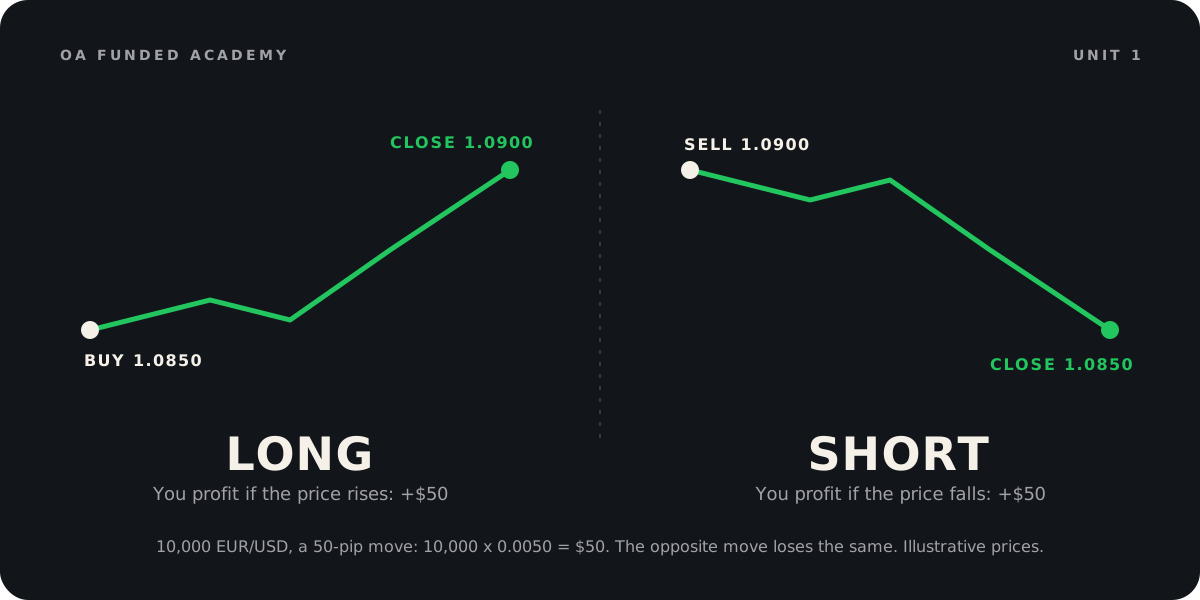
Going long means buying. You go long when your plan says the base currency is likely to strengthen against the quote currency. You make money if the price rises and lose money if it falls.
Going short means selling. You go short when your plan says the base currency is likely to weaken against the quote currency. You make money if the price falls and lose money if it rises.
New traders often ask how you can sell something you do not own. In everyday life you cannot. On a trading platform you are not handing over a pile of euros. You are opening a position, which is simply an open trade whose value changes as the price moves. The platform tracks the difference between where you opened and where you close. Selling first and buying back later is just the reverse order of buying first and selling later.
One more word you need: position size. That is how much of the base currency your trade controls. A position of 10,000 EUR/USD controls 10,000 euros. Bigger size means every price move is worth more money, in both directions.
Worked example
A long trade in dollars, on a $10,000 account
You have a $10,000 practice account. EUR/USD is 1.0800. Your plan expects the euro to strengthen, so you buy 10,000 EUR/USD. That position is worth 10,000 x 1.0800 = $10,800.
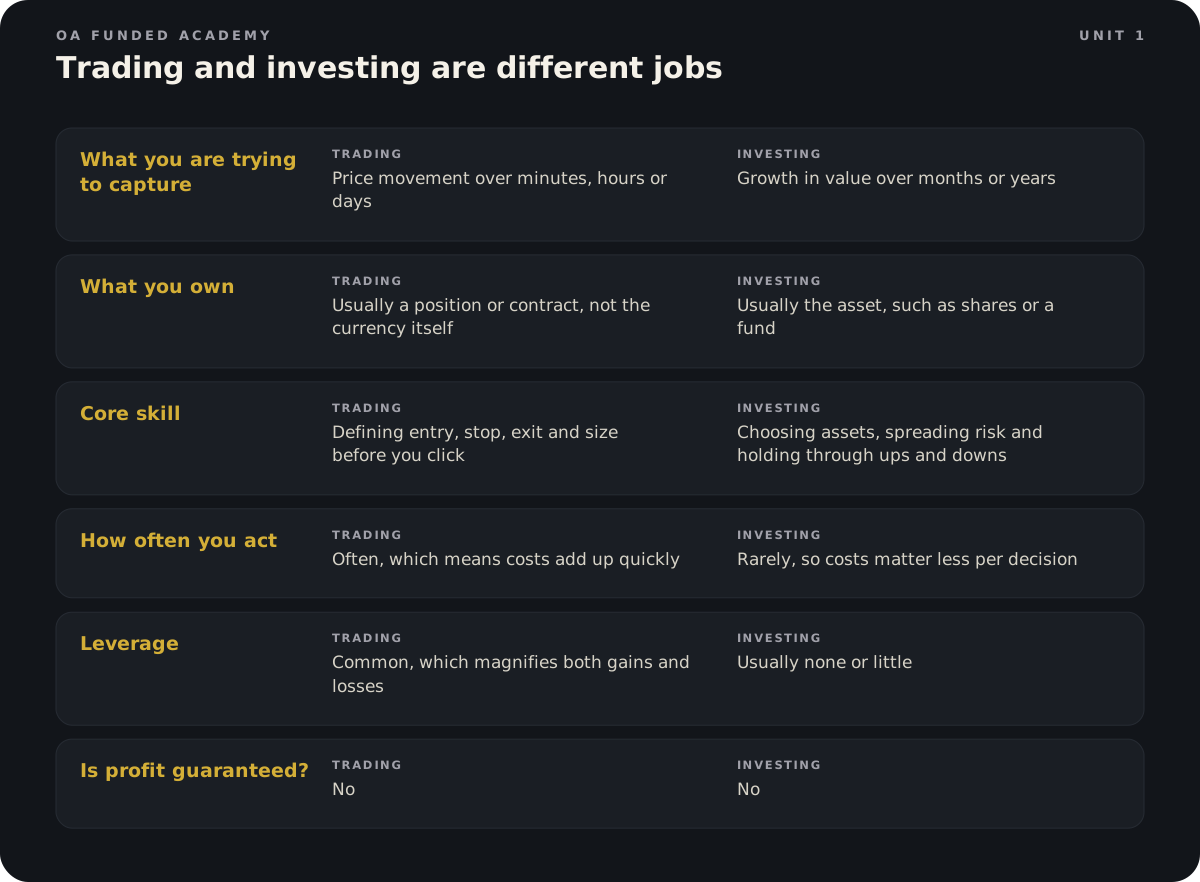
- Notice something straight away. A $10,800 position is bigger than your whole $10,000 account. That is possible because of leverage, which lets you control a position larger than your balance. Leverage makes every move count for more. It does not make you more right.
- Good outcome: the price rises to 1.0850. Your euros are now worth 10,000 x 1.0850 = $10,850. You close the trade. Result: $10,850 minus $10,800 = a $50 gain, before costs.
- Bad outcome: the price falls to 1.0760. Your euros are now worth 10,000 x 1.0760 = $10,760. You close the trade. Result: $10,760 minus $10,800 = a $40 loss, before costs.
- Now the costs. Every trade starts slightly behind because of the spread, the small gap between the buying price and the selling price. If that gap is 0.0001 on this pair, it costs 10,000 x 0.0001 = $1 on this size. Your $50 gain becomes about $49 and your $40 loss becomes about $41.
- As a share of the account: a $41 loss is 0.41% of $10,000. That is a small, survivable loss. The same move on a position ten times bigger would have cost about $410, or 4.1% of the account, in one trade.
Takeaway: The price move decides whether you are right. Your position size decides how much being right or wrong costs. Size is the part you control.
Worked example
A short trade in dollars, on a $25,000 account
You have a $25,000 practice account. GBP/USD is 1.2700. Your plan expects the pound to weaken against the dollar, so you sell 20,000 GBP/USD.
- When you sell, you gain if the price falls. Each 0.0001 move on 20,000 units is worth 20,000 x 0.0001 = $2.
- Good outcome: the price falls to 1.2640. That is a move of 1.2700 minus 1.2640 = 0.0060. Your gain is 20,000 x 0.0060 = $120, before costs.
- Bad outcome: the price rises to 1.2735. That is a move of 0.0035 against you. Your loss is 20,000 x 0.0035 = $70, before costs.
- As a share of the account: $70 is 0.28% of $25,000. You would barely notice it on the balance. That is exactly how a first trade should feel.
- Same pair, same move, opposite direction: a buyer at 1.2700 would have lost $120 in the first outcome and made $70 in the second. There is always someone on the other side who sees it differently.
Takeaway: Short is not a special trick. It is the mirror image of long. Work out your result the same way: size times the move, then subtract costs.
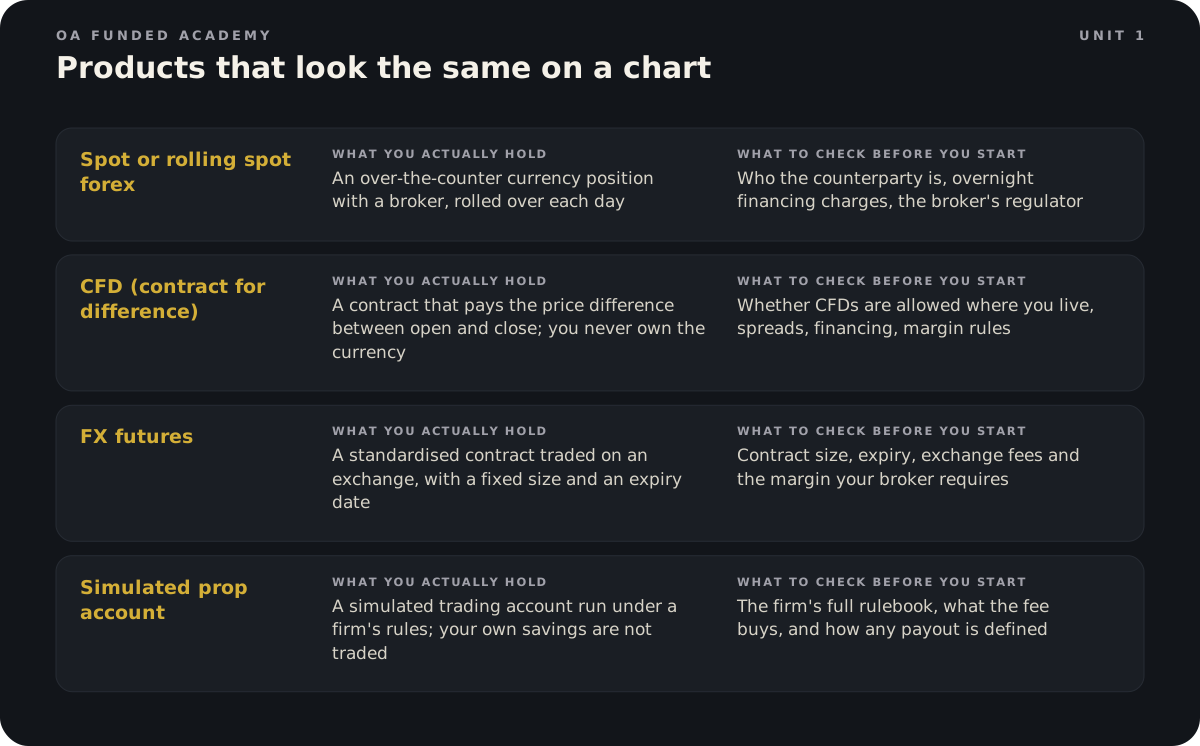
Where a prop firm fits, and where OA Funded fits
A proprietary trading firm, usually called a prop firm, gives traders an account to trade under a set of rules. Many retail-facing prop firms today, including this one, run accounts on simulated capital. That means the trades are executed in a simulated environment rather than with your own deposited money.
On OA Funded, every account, evaluation and funded, uses simulated capital, and your evaluation fee pays for access to the evaluation service. The platform is TradeLocker and the instruments are FX and indices. You will learn the full OA Funded rules in later units. For now, the point is simple: know which product you are trading before you trade it, wherever you trade.
A simulated account changes what is at stake, not how the market behaves. Spreads, fast moves and your own emotions still show up. Treat practice trades as if each dollar were real. Traders who treat a simulated account like a video game usually build habits that fail them later.
You sell 10,000 EUR/USD at 1.0800 and close at 1.0740. What is your result before costs?
How a trade actually happens, step by step
Every trade you ever take follows the same short sequence. Learn it now and the rest of the course hangs on it.
First, you form a plan: which pair, which direction, and why. Second, you decide where you would be wrong. That price becomes your stop-loss, an instruction to close the trade automatically if the price reaches it. Third, you choose a position size so that, if the stop is hit, the loss is an amount you have already accepted. Fourth, you place the order and check it before you send it. Fifth, you manage the trade according to your plan, not according to your mood. Sixth, you close it and write down what happened.
Notice what comes before clicking buy or sell: a reason, a place where you are wrong, and a size. Most beginners do it the other way round. They click, then think about the stop, then panic about the size. We will spend the next few units making the right order automatic.
A learner finishes a forex course. What has actually changed?
Avoid these
Common mistakes.
Mistake
Reading the pair backwards and buying when you meant to bet against the base currency
Do this instead
Say the full sentence before every trade: 'I am buying [base] and selling [quote] because I expect [base] to strengthen.'
Mistake
Treating forex as one identical product everywhere
Do this instead
Find out whether you are trading spot, a CFD, futures or a simulated account, and read that provider's terms.
Mistake
Starting with an income target such as '$2,000 a month'
Do this instead
Start with a skill goal and a loss limit. Income targets push you into oversized trades.
Mistake
Thinking you must own a currency before you can sell it
Do this instead
Understand that a short is an open position that gains when the price falls. The platform tracks the difference.
Mistake
Judging a trade only by whether it won
Do this instead
Judge it by whether you followed your plan: reason, stop, size and order check. Outcomes are partly luck.
Mistake
Treating a simulated account as a game and clicking freely
Do this instead
Trade practice and simulated accounts as if every dollar were your own, so the habits carry over.
Mistake
Trusting screenshots, signal sellers or 'guaranteed' returns
Do this instead
Treat any promise of profit as a warning sign. Check regulator warnings from bodies such as the CFTC and SEC.
Keep the language straight
Quick glossary.
- Forex
- Short for foreign exchange: the market where one currency is swapped for another.
- Exchange rate
- The price of one currency expressed in another, such as 1.0800 dollars per euro.
- Base currency
- The first currency in a pair. The price tells you what one unit of it costs.
- Quote currency
- The second currency in a pair. The price is expressed in units of it.
- Long
- A buy position that gains if the price rises.
- Short
- A sell position that gains if the price falls.
- Position size
- How much of the base currency a trade controls, for example 10,000 units.
- Spread
- The gap between the buying price and the selling price; a cost you pay on every trade.
- Leverage
- The ability to control a position larger than your account balance. It magnifies gains and losses.
- Over-the-counter (OTC)
- Trading arranged directly between parties rather than on one central exchange.
- Simulated capital
- Account money that exists in a simulated trading environment rather than as your own deposited funds.
Lesson check.
6 questions on the whole unit. Score 80% or more to show you have it.
1.You buy GBP/USD. What are you actually doing?
2.On a $10,000 practice account you buy 15,000 AUD/USD at 0.6500 and close at 0.6460. What is your result before costs, and what share of the account is it?
3.You sell 20,000 EUR/USD at 1.0900 and close at 1.0870. The spread costs 0.0001 on this pair. What is your result after the spread?
4.Which statement about a simulated prop account is accurate?
5.Which of these is inside your control as a trader?
6.A signal group says its members make $2,000 a month from a $10,000 account. What does that claim really imply?
Practice room
3 activitiesTurn the idea into a decision.
These are fictional learning scenarios. They never place trades or use real money. Complete the required checks to finish this lesson.
Finish this unit
Pass each required activity, then save the current lesson version to your record.
Public lesson Q&A
Ask what is still unclear.
No published questions yet.
Sources and review
- BIS: OTC foreign exchange turnover in April 2025 (Triennial Survey)Reviewed 2026-10-31Open (opens in a new tab)
- BIS media release: Global FX trading hits $9.6 trillion per day in April 2025Reviewed 2026-10-31Open (opens in a new tab)
- Investor.gov (SEC): Forex Trading for Individual InvestorsReviewed 2026-10-31Open (opens in a new tab)
- Babypips forum: Forex101, know what you are buying or sellingReviewed 2026-10-31Open (opens in a new tab)