Unit 02 · 38 min read
The Forex Market and Currency Pairs.
Decode any currency quote, understand bid, ask and spread, know which pairs and sessions suit a beginner, and stop accidentally placing the same bet three times.
- Level
- Beginner
- Revision
- mentor-2026-10
- Access
- Public
By the end, you can
- Read a forex quote correctly and say which currency strengthened
- Explain bid, ask and spread and calculate the spread cost of a trade in dollars
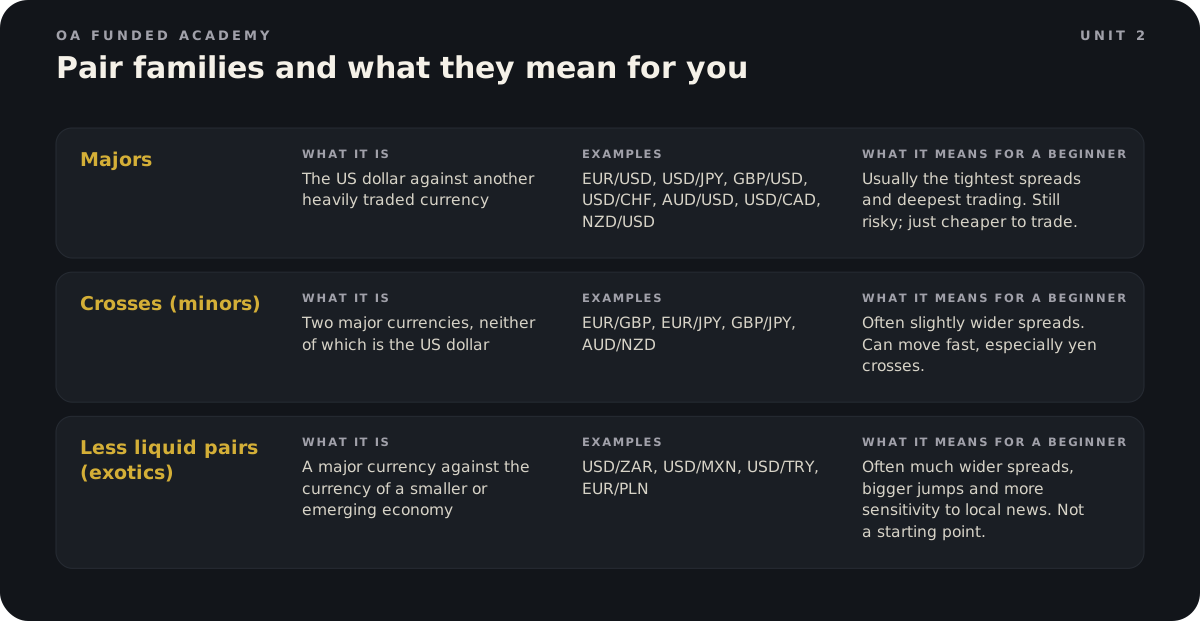
- Classify pairs as majors, crosses or less liquid pairs and explain why it matters
- Choose a watch window that fits the main trading sessions and your real life
- Add up hidden currency exposure across several open trades
Decode every pair, left to right
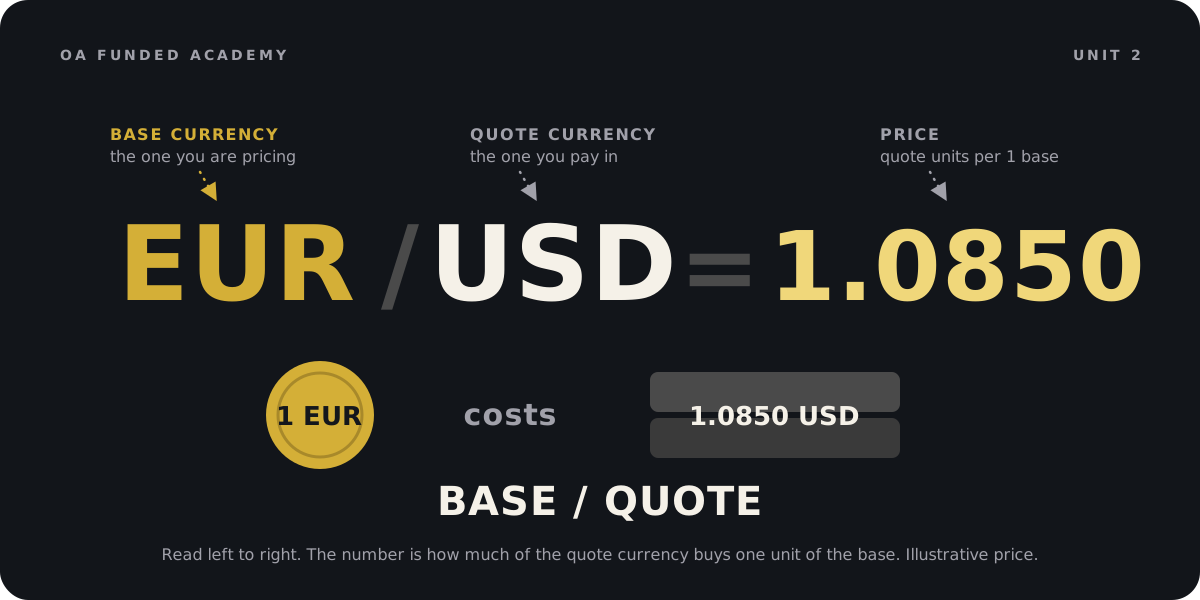
In Unit 1 you learned that every forex price is one currency measured in another. This unit turns that idea into a habit you can use on any pair you see.
Read every pair left to right. The first currency is the base. The second is the quote. The number is how much of the quote currency buys one unit of the base. AUD/USD at 0.6500 means one Australian dollar costs 65 US cents. USD/CAD at 1.3600 means one US dollar costs 1.36 Canadian dollars.
Currencies have three-letter codes. The ones you will see most are USD (US dollar), EUR (euro), JPY (Japanese yen), GBP (British pound), CHF (Swiss franc), AUD (Australian dollar), CAD (Canadian dollar) and NZD (New Zealand dollar).
Most pairs are shown to four or five decimal places, such as 1.0800 or 1.08004. Pairs that include the Japanese yen are shown to two or three, such as 150.00 or 150.004, because one yen is worth so little. Traders call the standard small step a pip. On most pairs a pip is 0.0001. On yen pairs it is 0.01. You will do full pip maths in Unit 4. For now, just recognise the word.
Worked example
Translate the move, then put a dollar figure on it
You are practising on a $10,000 account in US dollars. USD/JPY moves from 150.00 to 151.20 while you hold a long position of 10,000 USD/JPY.
- Base is USD. Quote is JPY. The number went up, so one dollar now buys more yen. The dollar strengthened against the yen. Your long position gains.
- The move is 151.20 minus 150.00 = 1.20 yen per dollar. On 10,000 units that is 10,000 x 1.20 = 12,000 yen.
- Your account is in dollars, so the platform converts the yen into dollars at the current rate: 12,000 divided by 151.20 = about $79.37 gain, before costs.
- As a share of your account: $79.37 is about 0.79% of $10,000.
- If the price had fallen from 150.00 to 149.40 instead, the move is 0.60 yen against you: 10,000 x 0.60 = 6,000 yen, divided by 149.40 = about $40.16 loss.
Takeaway: When the quote currency is not your account currency, the platform converts the result. The sentence 'which currency strengthened?' comes first; the maths follows.
GBP/USD rises from 1.2500 to 1.2600. What happened?
Bid, ask and spread: why every trade starts slightly behind
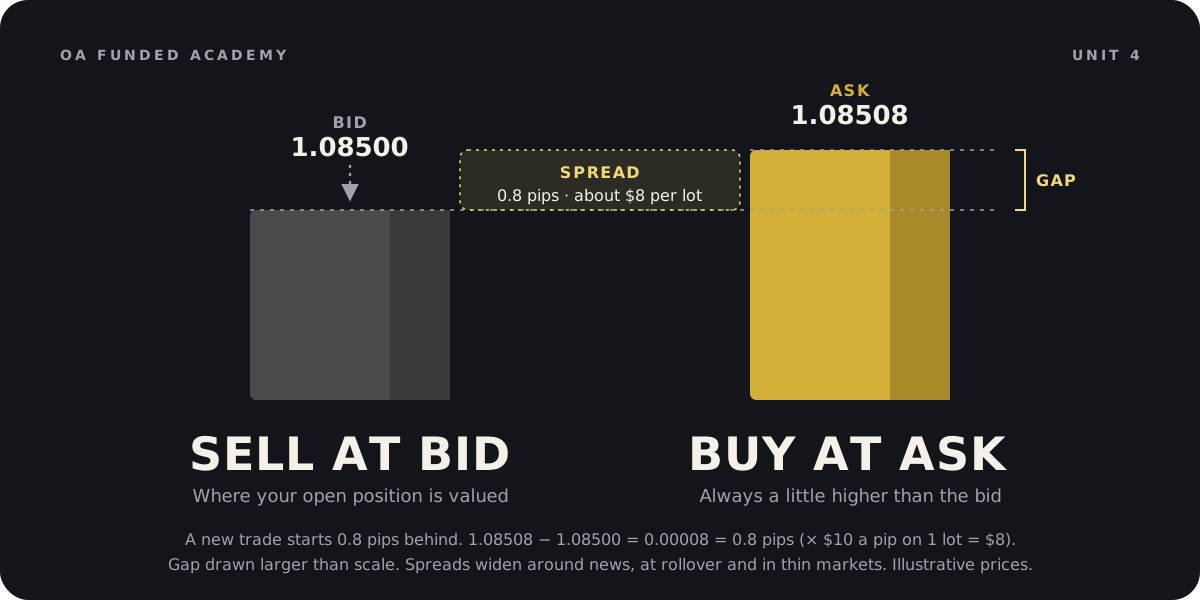
Your platform always shows two prices for a pair. The bid is the price at which you can sell. The ask is the price at which you can buy. The ask is always a little higher than the bid. The difference between them is the spread.
Think of the currency kiosk at the airport. It buys euros from you at one price and sells them to you at a higher price. The gap is how it gets paid. In trading, the spread works the same way, and it is a cost you pay the moment you open a trade.
That is why a brand-new trade shows a small loss even if the price has not moved. You bought at the ask, but your position is valued at the bid, which is where you could sell right now. The price has to move in your favour by at least the spread before you are back to zero.
Spreads are not fixed. They tend to be tight when many people are trading and wider when few are, such as late in the US afternoon, on holidays, or in the seconds around a big news release. A spread that is normally tiny can widen several times in a fast market. Check it before you click, every time.
Worked example
What the spread costs you over a week
You trade 20,000 units per trade on a $10,000 account. You are choosing between three pairs. The spreads below are illustrative, not quotes from any provider.
- EUR/USD with a spread of 0.0001: cost per trade = 20,000 x 0.0001 = $2.00.
- GBP/JPY at 190.00 with a spread of 0.03: cost = 20,000 x 0.03 = 600 yen, divided by 190.00 = about $3.16 per trade.
- USD/ZAR (US dollar against South African rand) at 18.00 with a spread of 0.0150: cost = 20,000 x 0.0150 = 300 rand, divided by 18.00 = about $16.67 per trade.
- Now take ten trades a week. EUR/USD costs about $20.00. GBP/JPY costs about $31.60. USD/ZAR costs about $166.70.
- As a share of the account per week: 0.20%, 0.32% and 1.67%. On the last pair you lose 1.67% of the account every week before a single trade has gone against you.
Takeaway: The spread is a toll you pay on every trade. Wide-spread pairs make you pay far more for the same number of decisions. Beginners should start where the toll is low.
One market, open all week, in shifts
The forex market runs from Sunday evening to Friday evening, New York time, almost around the clock. It does this because trading passes from one financial centre to the next as the day moves around the world. Traders talk about sessions: the Asia-Pacific session (Sydney and Tokyo), the London session and the New York session.
Each session has a personality. Asia is often calmer for euro and pound pairs, with more activity in yen and Australian dollar pairs. London is usually the busiest single session. When London and New York are both open, many pairs see their highest trading activity of the day, and spreads on majors are often at their tightest.
The quietest stretch is usually the late New York afternoon into the early Asian session. Around that time, roughly 5pm New York time, many providers roll positions over to the next day, and spreads can widen for a few minutes. Weekends are closed, and Monday can open at a different price from Friday's close. That jump is called a gap.
Clock changes catch everyone. The US, the UK, Europe and Australia switch daylight saving time on different dates, so session times in your own time zone shift a couple of times a year. Use a market-hours tool set to your local time rather than memorising a table.
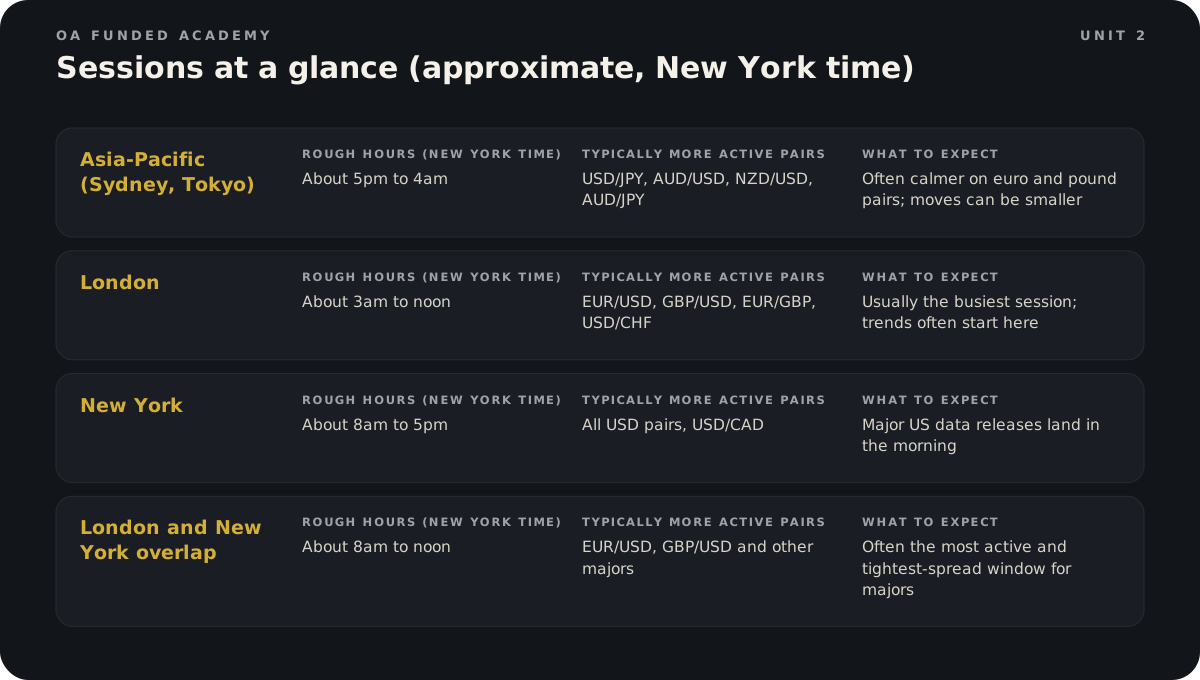
You want to watch EUR/USD when trading activity is usually highest and spreads are often tight. When should you look?
Three trades can be one bet
Here is a mistake almost every new trader makes. You open a long on EUR/USD, a long on GBP/USD and a short on USD/CHF, and you feel nicely spread out across three different markets.
Now look at what each trade is really saying. Long EUR/USD means 'dollar weaker'. Long GBP/USD means 'dollar weaker'. Short USD/CHF means selling the dollar against the franc, which also means 'dollar weaker'. That is one opinion about the US dollar, placed three times.
If the dollar strengthens on a piece of news, all three can lose together. Your risk is not three small separate risks. It is one bigger risk wearing three tickets. Before you add a trade, write down which currency each open position is buying and which it is selling, and add them up.
Worked example
The dollar bet in dollars, on a $25,000 account
You hold three positions of 10,000 units each on a $25,000 account: long EUR/USD at 1.0800, long GBP/USD at 1.2700 and short USD/CHF at 0.8800. You think of each as 'about a $60 to $70 risk'. Then strong US data comes out and the dollar rises across the board.
- EUR/USD falls to 1.0740. Move against you: 0.0060. Loss: 10,000 x 0.0060 = $60.
- GBP/USD falls to 1.2630. Move against you: 0.0070. Loss: 10,000 x 0.0070 = $70.
- USD/CHF rises to 0.8860. You are short, so this is 0.0060 against you. Loss: 10,000 x 0.0060 = 60 francs, converted at 0.8860 = about $67.72.
- Total loss: $60 + $70 + $67.72 = about $197.72, from one news release.
- As a share of the account: $197.72 is about 0.79% of $25,000. You meant to take three risks of roughly 0.25% each that would not all lose together. Instead you took one risk of nearly 0.8% that did.
Takeaway: Count currencies, not tickets. If several trades share the same currency on the same side, treat them as one position and size the total accordingly.
Which set of trades is most likely to lose all at once if the US dollar strengthens?
Avoid these
Common mistakes.
Mistake
Reading the pair backwards and thinking a rising USD/JPY means the yen strengthened
Do this instead
Base first, quote second. A rising number always means the base strengthened.
Mistake
Ignoring the spread because it looks tiny
Do this instead
Multiply it by your size and by your number of trades. Check it before every order.
Mistake
Calling every non-dollar pair 'exotic'
Do this instead
Separate crosses such as EUR/GBP from less liquid pairs such as USD/ZAR. They behave and cost differently.
Mistake
Choosing pairs because they moved a lot yesterday
Do this instead
Choose one or two majors that are active in your session and learn how they normally behave.
Mistake
Trading through the night and losing sleep
Do this instead
Pick a window that fits your life. Tired decisions are expensive.
Mistake
Opening several trades that all sell the same currency
Do this instead
List what each trade buys and sells, and size the combined exposure as one position.
Mistake
Forgetting that clocks change
Do this instead
Use a market-hours tool in your local time and recheck around daylight saving dates.
Keep the language straight
Quick glossary.
- Bid
- The price at which you can sell the base currency.
- Ask
- The price at which you can buy the base currency. It is higher than the bid.
- Spread
- The difference between the ask and the bid; a cost paid on every trade.
- Pip
- The standard small price step: 0.0001 on most pairs and 0.01 on yen pairs.
- Major pair
- The US dollar paired with another heavily traded currency, such as EUR/USD.
- Cross pair
- A pair of two major currencies that does not include the US dollar, such as EUR/GBP.
- Liquidity
- How easily you can trade without moving the price much. High liquidity usually means tighter spreads.
- Session
- The part of the day when a major financial centre, such as London or New York, is open.
- Rollover
- The daily point, usually around 5pm New York time, when providers carry open positions to the next day.
- Gap
- A jump between one price and the next with no trading in between, common after weekends.
- Currency exposure
- How much you stand to gain or lose if one particular currency strengthens or weakens, summed across all trades.
Lesson check.
6 questions on the whole unit. Score 80% or more to show you have it.
1.USD/CAD falls from 1.3600 to 1.3550. Which statement is correct?
2.You trade 30,000 units of EUR/USD per trade with a spread of 0.0001, and you take 20 trades a week on a $10,000 account. What does the spread cost you each week?
3.On a US dollar account you hold a long of 10,000 USD/JPY. The price rises from 150.00 to 150.75. What is the result before costs?
4.How should you classify EUR/GBP and USD/MXN?
5.Around 5pm New York time you notice the EUR/USD spread is about three times its normal size. What is the sensible response?
6.You are long 10,000 AUD/USD and long 10,000 NZD/USD. Strong US data comes out. AUD/USD falls 0.0040 and NZD/USD falls 0.0050. What happened to your risk?
Practice room
3 activitiesTurn the idea into a decision.
These are fictional learning scenarios. They never place trades or use real money. Complete the required checks to finish this lesson.
Finish this unit
Pass each required activity, then save the current lesson version to your record.
Public lesson Q&A
Ask what is still unclear.
No published questions yet.
Sources and review
- BIS: OTC foreign exchange turnover in April 2025 (Triennial Survey)Reviewed 2026-10-31Open (opens in a new tab)
- Babypips School: Forex Trading Sessions (Sydney, Tokyo, London and New York)Reviewed 2026-10-31Open (opens in a new tab)
- Investor.gov (SEC): Forex Trading for Individual InvestorsReviewed 2026-10-31Open (opens in a new tab)