

Unit 17 · 35 min read
Performance Psychology.
Build routines for confidence, attention, recovery and sustainable decision-making: catch tilt early, size for loss streaks, stay steady near a target, and know when to stop for the day.
- Level
- Intermediate
- Revision
- mentor-2026-10
- Access
- Public
By the end, you can
- Recognise the early physical and behavioural signs of tilt in yourself
- Calculate how a normal losing streak hits your account at your current risk per trade
- Use a written routine to keep execution steady when a target or limit is close
- Replace outcome goals with process goals you can score every session
- Write numeric stop-trading rules that end the session before emotion takes over
- Treat sleep, stress and workload as inputs to your risk decisions
Tilt starts before the big mistake
You already know your setups. Most bad days are not caused by missing knowledge. They are caused by a state change: you stop trading your plan and start trading your feelings. Poker players call it tilt, and the word fits trading well.
Tilt rarely arrives as one dramatic decision. It builds. Your jaw tightens. You lean closer to the screen. You drop to a lower timeframe to find something, anything, to take. You skip the checklist because it feels slow. Each step looks small, and that is why it works on you.
The fix is to learn your own early signs and give them a fixed response. Write down the three things you notice first when you are getting hot. For many traders it is a faster heartbeat, clicking between charts, and saying 'just one more' out loud. When you notice one of your signs, you stand up and walk away for ten minutes. No debate, no exceptions. You are not trying to feel calm. You are trying to stop making decisions while you are not calm.
Worked example
How a tilt spiral turns a small loss into a big one
Simulated $10,000 account. The plan says risk 1% ($100) per trade and stop for the day after two losses (-$200). The numbers are hypothetical and show the mechanics only.
- Trade 1 follows the plan and hits its stop: -$100. Balance $9,900.
- The trader feels robbed and doubles size on the next idea, which is not a planned setup: -$200. Balance $9,700. The plan's daily stop has now been passed.
- Angry, they triple the original size to 'get it all back in one': -$300. Balance $9,400.
- Total for the session: -$600, which is 6% of the account in about an hour.
- If the trader had stopped at the plan's two-loss rule, the worst case was -$200, which is 2%.
Takeaway: The first loss was a normal cost of trading. The other $400 came from the state, not the strategy. A stop-trading rule exists to cap the damage the state can do.
You have taken two planned losses this morning and you notice you are clicking quickly between charts looking for a trade. What is the best next action?
Loss streaks are maths, not a verdict
Three losses in a row feels like a message. Usually it is just probability. Say your strategy wins 45% of the time, so it loses 55% of the time. The chance of five losses in a row in any particular five trades is about 5% (0.55 multiplied by itself five times). That sounds rare. But over 100 trades, a computer simulation of that strategy shows a run of five or more losses in roughly nine out of ten samples, and a run of eight or more in about three out of ten.
So a streak is not proof the edge is gone. It is the expected weather of a strategy that wins less than half the time. What matters is whether you followed the plan during the streak and whether your size lets you survive it.
When should a streak make you review the strategy? When the losses come from trades that broke your rules, when market conditions have clearly changed from the ones you tested, or when the streak is longer than anything in your tested history. Review on the weekend with your journal open. Do not rewrite the strategy in the middle of a session because you are hurting.
Worked example
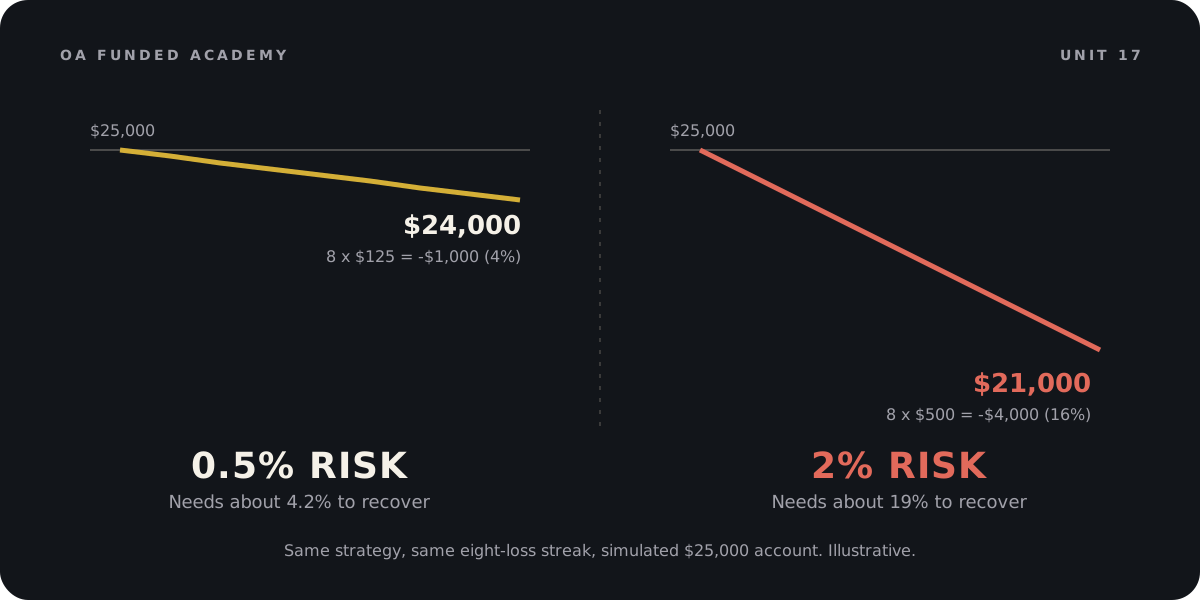
The same eight-loss streak at two risk sizes
Simulated $25,000 account. Two traders run the same strategy and both hit an eight-trade losing streak. For simplicity each loss is a fixed dollar amount based on the starting balance.
- Trader A risks 0.5% per trade: $25,000 x 0.005 = $125 per loss.
- Eight losses: 8 x $125 = $1,000. That is 4% of the account. Balance $24,000.
- Trader B risks 2% per trade: $25,000 x 0.02 = $500 per loss.
- Eight losses: 8 x $500 = $4,000. That is 16% of the account. Balance $21,000.
- To get back to $25,000, Trader A needs about 4.2% on $24,000. Trader B needs about 19% on $21,000.
Takeaway: Your risk per trade decides whether a normal streak is an annoying week or the end of the account. Size for the streak you will eventually meet, not for the win you hope comes next.
Fear near a target
Something odd happens when you get close to a goal. You stop trying to execute well and start trying not to lose what you have. Traders describe it the same way again and again: you move stops to break-even too early, close winners at the first sign of a pullback, skip valid setups, or sit frozen with the platform open.
The fear is understandable. It is also expensive, because it changes the shape of your results. Your losses stay full size while your wins shrink. A strategy that had a positive edge can turn negative just from how you manage it.
Here is the routine I would use. First, write down the exact trades you will take and how you will manage them, the same way you did when you were far from the target. Second, keep the same risk per trade. Do not cut it in half out of fear or double it to finish quickly. Third, hide the profit number on the platform if you can, and look at your checklist instead. Your job on the next trade is identical to your job on the first trade of the account.
Worked example
What cutting winners does to your expectancy
Simulated $10,000 account. A trader risks $100 per trade and normally targets $200 (2R). Their journal shows a 45% win rate. These are hypothetical figures used to show the arithmetic, not typical results.
- Normal management: 0.45 x $200 = $90 from wins. 0.55 x $100 = $55 from losses. Expected result per trade: $90 - $55 = +$35.
- Near the target, fear makes them close winners at +$40 while losers still run to -$100.
- Fear management: 0.45 x $40 = $18 from wins. Losses are still $55. Expected result per trade: $18 - $55 = -$37.
- Same entries, same win rate. The only change is exit behaviour, and the average trade flipped from about +$35 to about -$37.
Takeaway: Protecting gains by snatching small wins can quietly make a working plan a losing one. Manage the trade by the plan you tested, not by the distance to your goal.
Overconfidence after wins
A good week feels like proof that you have figured it out. That feeling is where a lot of accounts get damaged. After wins, traders loosen their entry criteria, add trades that are 'nearly' setups, and increase size without deciding to. The market did not change. Your threshold did.
Real confidence comes from evidence that you can follow the plan, not from the last five results. Five wins in a row says very little about skill. It is a tiny sample, and the same probability that produces loss streaks produces win streaks too.
Give yourself a rule for good days the same way you have one for bad days. Size changes happen only at a scheduled review, based on a set number of trades, never in the middle of a hot streak. If you hit your best day in a month, consider ending the session early. The urge to keep going while you are 'in the zone' is the same impulse as revenge trading, just with a better mood attached.
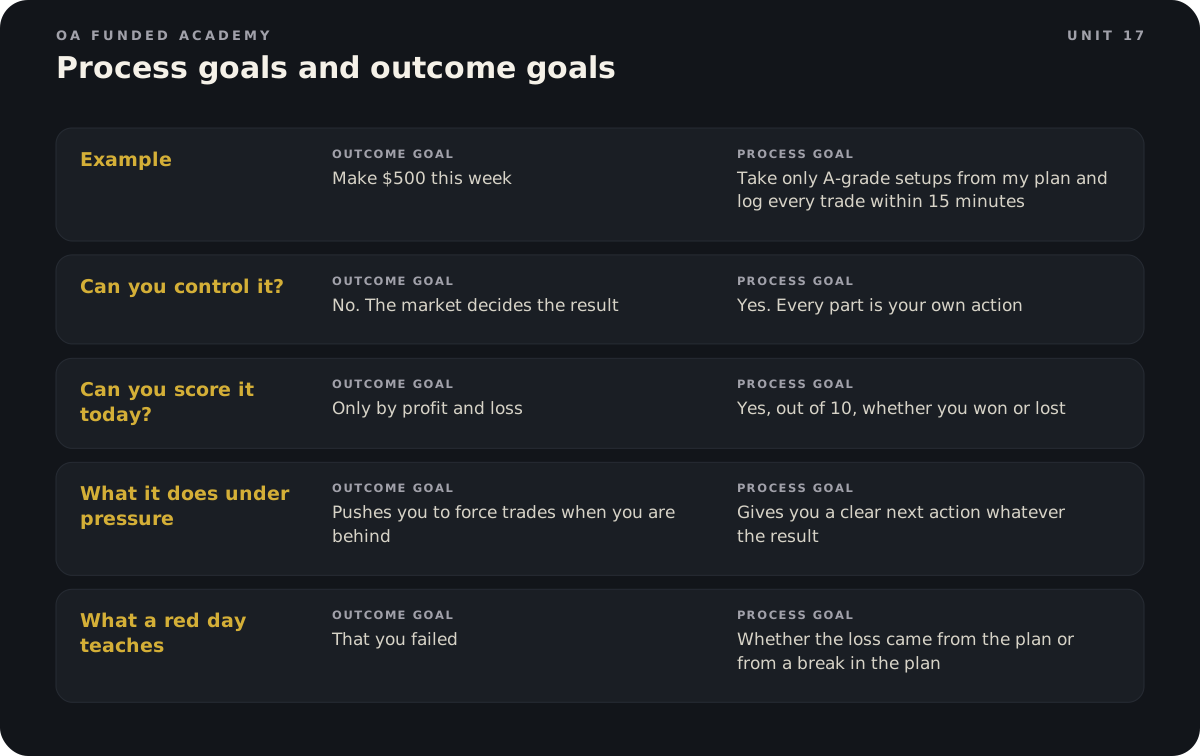
Which of these is a process goal?
A pre-session routine that takes ten minutes
Athletes warm up because the first minutes of performance are where mistakes cluster. Traders are no different. A short routine moves you from life mode into trading mode and catches problems before they cost money.
Here is a routine you can adapt. One: rate your state from 1 to 10 for sleep, stress and focus, and write the numbers down. Two: check the economic calendar for high-impact events in your session and mark them. Three: mark your key levels on the pairs or indices you trade, nothing else. Four: read your setup rules and your risk per trade out loud. Five: write today's stop-trading rules on a sticky note on your screen. Six: set one process goal for the session.
End the session with a matching shutdown. Log every trade, score your process goal out of 10, and write one sentence about your state. Over a month, those notes show you patterns you cannot see day to day, like your worst trades clustering after short nights or on days you skipped the routine.
Sleep, stress and workload are risk inputs
You would never trade without checking your risk per trade. Most traders never check the state of the person placing the trade. That person matters. A 2020 study in Nature and Science of Sleep restricted healthy adults to five hours of sleep for five nights. They gathered less information before deciding and took more risks on a card task. Interestingly, people who were normally the most careful changed the most.
That is exactly the trader who says 'I am usually disciplined, I do not know what happened this week.' Several short nights, a stressful job, a family problem or a long commute all reduce the attention you bring to the screen.
Treat it like any other risk. If your state score is low, reduce what you do: trade one market instead of three, take only your highest-quality setup, or take the day off. Protect a regular sleep window around your session the way you protect your stop loss. Build a routine that can survive an ordinary week of life, not one that only works on your best days.
You have slept about five hours a night for the last four nights because of work. Your setups look good this morning and you feel fine. What does this lesson suggest?
Avoid these
Common mistakes.
Mistake
Doubling size after a loss to win it back quickly
Do this instead
Keep risk per trade fixed and follow your consecutive-loss stop. The next trade has no connection to the last one.
Mistake
Treating a three- or five-trade losing streak as proof the strategy is broken
Do this instead
Compare the streak with your tested history and check whether the trades followed your rules. Review on the weekend, not mid-session.
Mistake
Cutting winners early when close to a target
Do this instead
Manage every trade with the plan you tested. Hide the profit figure if it pulls your attention, and score execution instead.
Mistake
Raising size after a winning week because you feel confident
Do this instead
Change size only at a scheduled review, based on a set number of trades and your journal, never during a streak.
Mistake
Setting only outcome goals such as a weekly dollar figure
Do this instead
Set one process goal per session that you control and can score out of 10 whatever the market does.
Mistake
Deciding stop-trading rules in the moment
Do this instead
Write numeric stop rules before the session and put them where you can see them.
Mistake
Trading through poor sleep, illness or heavy stress
Do this instead
Rate your state before every session and reduce activity or skip the session when the score is low.
Keep the language straight
Quick glossary.
- Tilt
- An emotional state in which you stop following your plan and start trading to relieve a feeling, often after a loss.
- Revenge trading
- Taking an unplanned trade, often at larger size, to win back a recent loss quickly.
- Losing streak
- A run of consecutive losing trades. Every strategy with a win rate below 100% will produce them.
- Expectancy
- The average amount a trade makes or loses over many trades: win rate x average win minus loss rate x average loss.
- Process goal
- A goal about your own actions, such as following a checklist, that you control and can score regardless of profit.
- Outcome goal
- A goal about a result the market decides, such as a dollar amount or win rate.
- Size creep
- Gradually increasing risk per trade without a deliberate decision, usually after a run of wins.
- Stop-trading rule
- A pre-set, numeric condition that ends your session, such as two consecutive losses or a daily loss amount.
Lesson check.
6 questions on the whole unit. Score 80% or more to show you have it.
1.You risk $100 a trade with a $250 target and a 40% win rate. Near a goal, fear makes you close winners at +$60 while losers still run to -$100. What is your expected result per trade now?
2.A $10,000 simulated account risks 1.5% per trade and runs into a six-trade losing streak. Using a fixed loss based on the starting balance, what does the streak cost and what gain is needed to recover?
3.How does tilt usually show up?
4.You have won five trades in a row and feel you have figured the market out. What does this unit suggest?
5.When should a losing streak make you review the strategy itself?
6.Which of these is the best-written stop-trading rule?
Practice room
3 activitiesTurn the idea into a decision.
These are fictional learning scenarios. They never place trades or use real money. Complete the required checks to finish this lesson.
Finish this unit
Pass each required activity, then save the current lesson version to your record.
Public lesson Q&A
Ask what is still unclear.
No published questions yet.
Sources and review
- Salfi et al. (2020), Effects of Total and Partial Sleep Deprivation on Reflection Impulsivity and Risk-Taking, Nature and Science of SleepReviewed 2026-10-31Open (opens in a new tab)
- NexusFi: Brett Steenbarger on replacing performance goals with process goalsReviewed 2026-10-31Open (opens in a new tab)
- BabyPips: Psychology, how to set trading goalsReviewed 2026-10-31Open (opens in a new tab)
- FXStreet: Revenge trading, the brain science behind bad trades and how you stop itReviewed 2026-10-31Open (opens in a new tab)