

Unit 16 · 36 min read
Managing a Funded Account.
Passing changes the job. In the evaluation you were working toward a target. On a funded account the job is to protect the floor, run the same tested process, and plan around payout cycles without letting them push you. This unit covers how the funded stage works on OA Funded, what a payout does to your balance and your floor, and the routines that keep a funded trader steady.
- Level
- Intermediate
- Revision
- mentor-2026-10
- Access
- Public
By the end, you can
- Describe the funded-stage rules on OA Funded and how they differ from the evaluation
- Calculate room to the static floor before and after a payout
- Plan a 14-calendar-day payout cycle with five traded days and the payout minimum (1% of the account or $100, whichever is higher)
- Build a news-day routine for the funded window
- Write if-then rules for the risky moments: just after passing, deep in a drawdown and just after a payout
Passing changes the job
Here is a feeling almost every trader has after passing: relief, then a quiet itch to go bigger. You proved yourself. The account is funded. Surely you can loosen up a little.
That itch is the most expensive thought in prop trading. Practitioner write-ups and forum threads tell the same story again and again: a trader passes with tight, boring risk, raises size in the first funded weeks, and gives the account back. Nothing about the market changed. The trader changed.
So start with a simple frame. The evaluation asked you to reach a target without touching a floor. The funded stage asks you to keep doing the exact process that got you there, cycle after cycle, while the floor stays in the same place. The skills are the same. The temptation is new.
A reminder on what the account is. On OA Funded every account, evaluation and funded, uses simulated capital. Funded traders keep 80% of profits as standard. None of that means profits or payouts are guaranteed. They depend on how you trade, cycle by cycle.
What the funded stage looks like on OA Funded
After you pass Phase 2 and complete identity verification, your funded account follows in under 3 business days. Your rules are versioned when you buy, and OA Funded makes no retroactive adverse changes.
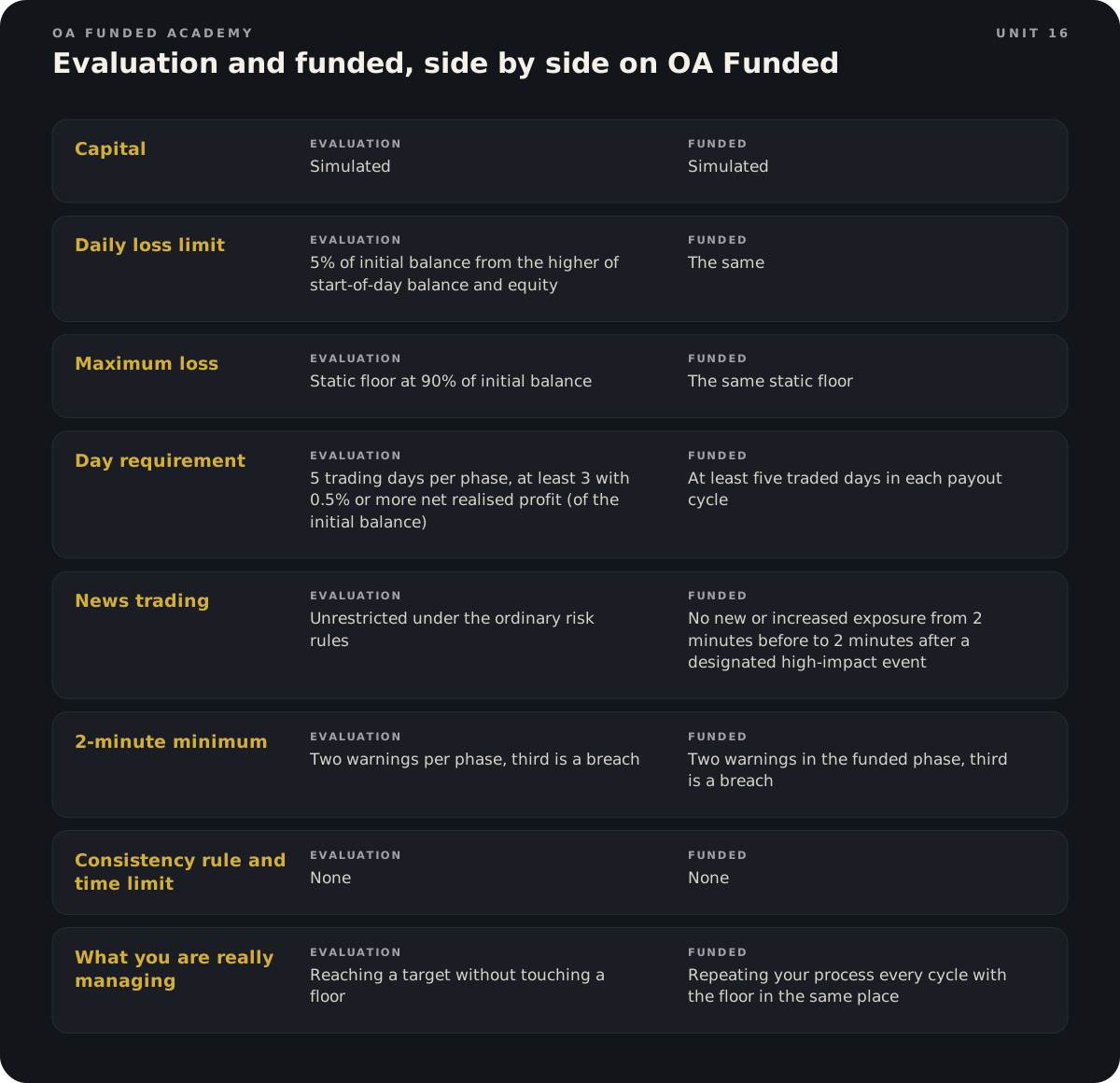
The same 5% daily loss limit and static 90% equity floor apply on the funded account. There is no time limit and no consistency rule. You need at least five traded days in each payout cycle.
Two things change. First, the news window. On funded accounts, you cannot open or add to positions from two minutes before to two minutes after a designated high-impact event. Second, the duration rule resets: you get two warnings in each phase (Phase 1, Phase 2 and funded), and the third trade closed in under 2 minutes in that phase is a breach.
Everything else from the account rules still applies: an account breaches if no trade is taken on it for 7 days, weekend holding is not allowed, and hedging, grid and martingale are banned.
The floor never moves, so every payout matters
Your equity, including open trades, must stay above 90% of your initial balance, and that floor never moves up with your profits. On a $10,000 account the floor is $9,000. On a $25,000 account it is $22,500.
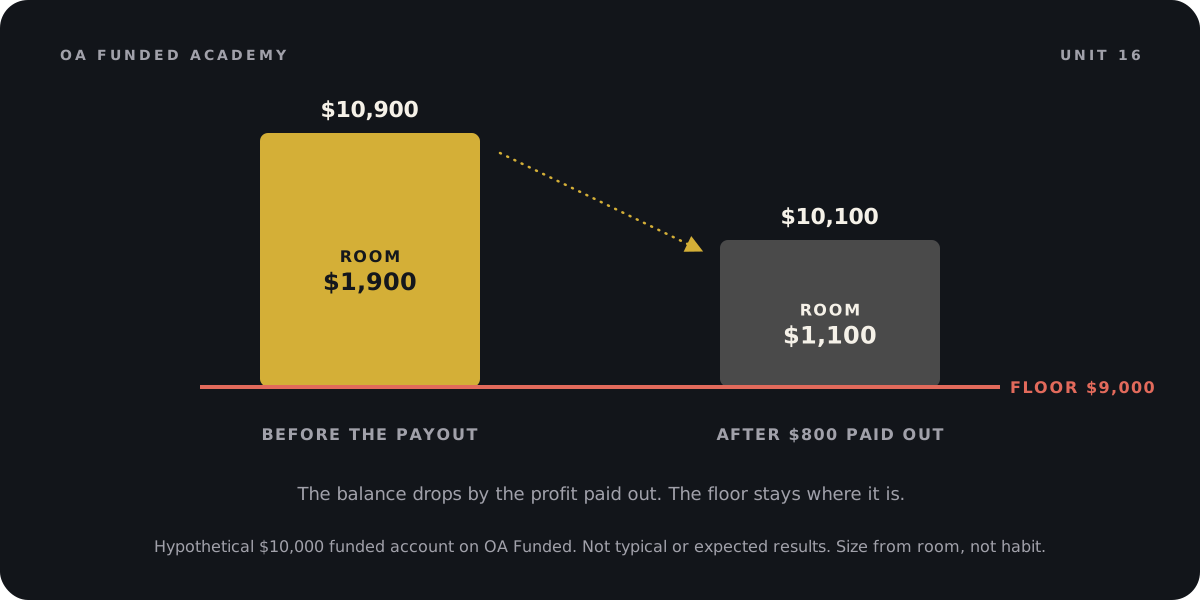
Now add payouts. After a payout, your balance is reduced by the profit paid out. Your static equity floor stays the same.
Think about what that means. Profit you build up in a cycle is a cushion between you and the floor. A payout takes that cushion away and you start the next cycle closer to the floor than you ended the last one. That is not a problem. It is just arithmetic. But if you keep trading the size you were comfortable with on a big cushion, you are taking more risk relative to your room than you think.
The habit: after every payout, recalculate room to the floor and reset your size to fit it.
Worked example
What a payout does to your room
A hypothetical $10,000 funded account on OA Funded. Near the end of a cycle the closed balance is $10,900 with no trades open. The figures are for illustration only and are not typical or expected results.
- Before the payout: static floor $9,000. Room to the floor is $10,900 minus $9,000, which is $1,900.
- Suppose $800 of profit is paid out. The balance is reduced by the profit paid out, so it falls to $10,100.
- After the payout: the static floor is still $9,000. Room is now $10,100 minus $9,000, which is $1,100.
- Your size was $150 a trade, which allowed about 12 losers before the floor. With $1,100 of room, $150 a trade allows 7.
- To keep the same safety margin, drop to around $90 a trade ($1,100 divided by 12) until the cushion is rebuilt.
Takeaway: Size from room, not from habit. After a payout, room shrinks while the floor stays fixed.
The minimum is 1% of the account or $100, whichever is higher, applied to your share. Below it, nothing is lost: it stays owed to you. The other payout conditions (14 days, five traded days) still apply.
On a $25,000 OA Funded account, the balance is $26,000. After a payout the balance is reduced by $700 of profit paid out. Where is the static floor now?
Planning a payout cycle
On OA Funded, your first 14-calendar-day cycle starts with your first trade on the funded account. You need at least five traded days in the cycle. You can request a payout once per 14-calendar-day cycle, and each later cycle starts from your last payout payment. The minimum payout is 1% of the account or $100, whichever is higher. Payouts are paid by bank transfer, and requests are approved in under 48 hours. Your dashboard shows the amount available to request when you meet the payout conditions.
Planning is about removing pressure. Five traded days across 14 calendar days is a light requirement if you spread it out. It becomes a heavy one if you trade twice in the first week, wait, then realise on day 12 that you need three more days. That is when traders take setups they would normally skip.
A simple plan: aim to trade on two or three days in each week of the cycle, only on your setups. That gets you past five traded days with room to spare, without inventing trades. Write the cycle start date and the 14-day mark on paper the day you place your first funded trade.
And plan for the cycle that does not end in profit. Some will not. That is a normal part of trading, not a sign you need to press. The next cycle starts the same way: same size rules, same setups.
Tap the days you close a trade. The cycle starts with your first funded trade.
*If the other conditions are also met, including the payout minimum. Spread your days out; forcing trades to reach five is how good cycles go wrong.
You passed Phase 2 on the 3rd, your funded account arrived on the 5th, and you placed your first funded trade on the 8th. When does your first 14-calendar-day payout cycle start?
Worked example
Protecting the floor in a funded drawdown
A $25,000 funded account on OA Funded. After a rough stretch the balance and equity at the start of the trading day are $23,600. No trades are open. Normal risk is $125 a trade.
- Static floor: 90% of $25,000 is $22,500. Room is $23,600 minus $22,500, which is $1,100.
- Daily floor: $23,600 minus $1,250 (5% of $25,000) is $22,350. The static floor is higher, so it is the line today.
- At $125 a trade, eight losers would take you to the floor ($1,000 of $1,100).
- Cut to $60 a trade. Now eighteen losers fit inside the room.
- Return to $125 only after the balance is back above a level you wrote in advance, for example $24,300.
Takeaway: In a funded drawdown, cut size first and set the recovery point before you need it. There is no time limit, so slow is allowed.
The news window, as a daily routine
During the evaluation, news trading is unrestricted under the ordinary risk rules. On a funded account, you may not create or increase exposure from two minutes before to two minutes after a designated, directly relevant high-impact event. You can still hold, close or reduce positions. Your stop loss and take profit can still execute. A pending order that triggers inside the window counts as new exposure. On a funded account, the first trade opened in a window is a warning. The next one is a breach.
If you traded news during your evaluation, this is the habit you most need to rebuild. Make it a morning routine. Check the designated events for the day. Write the window times on a sticky note next to your screen. Look at every pending order and ask whether it could fill inside a window. If it could, cancel it or move it.
Many funded traders go further and simply stand aside for a few minutes on either side of the biggest releases. Spreads widen and fills get worse around them anyway. That is a personal choice, not an OA Funded rule, but it removes a whole category of mistakes.
Staying consistent without a consistency rule
On OA Funded there is no consistency rule. Not in the evaluation, and not on the funded account. One big day does not stop you passing or getting paid.
That freedom is real, and it deserves respect. A rule-free big day is fine when it comes from your normal size catching a big move. It is a warning sign when it comes from size you would not normally use. The rules also list 'all-in' position sizing that puts a disproportionate share of your account equity at risk in one trade or series of trades as a prohibited practice.
So keep your own consistency, of process rather than profit. Same risk per trade. Same setups. Same daily stop. Your journal should look boring from one cycle to the next. Boring is what a repeatable process looks like.
A funded trader on OA Funded has one day that makes most of the cycle's profit, using their normal risk per trade. What does the consistency rule say about that?
Avoid these
Common mistakes.
Mistake
Raising risk the week after passing
Do this instead
Keep evaluation size for at least a full payout cycle and change it only after a written review of journal data.
Mistake
Keeping the same size after a payout
Do this instead
A payout reduces the balance by the profit paid out while the floor stays the same. Recalculate room and resize.
Mistake
Counting the first cycle from the pass date
Do this instead
The first 14-calendar-day cycle starts with your first trade on the funded account.
Mistake
Forcing trades to reach five traded days
Do this instead
Spread trading across the cycle from the start, aiming for two or three days a week on your own setups.
Mistake
Trading news on a funded account the way you did in the evaluation
Do this instead
On a funded account, do not create or increase exposure from two minutes before to two minutes after a designated high-impact event, and check pending orders each morning.
Mistake
Reading 'no consistency rule' as 'any size is fine'
Do this instead
Keep process consistency yourself. All-in position sizing is a prohibited practice on OA Funded.
Mistake
Treating a payout as guaranteed income
Do this instead
Payouts depend on meeting the conditions and on your trading. Judge each cycle on process, not on whether it paid.
Keep the language straight
Quick glossary.
- Funded account
- On OA Funded, the simulated-capital account you trade after passing both phases and identity verification.
- Payout cycle
- On OA Funded, a 14-calendar-day period. The first starts with your first funded trade, later ones from your last payout payment.
- Traded day
- A day on which you close at least one trade on the account. It is counted the same way as a trading day in the evaluation.
- Profit split
- The share of profits a funded trader keeps. On OA Funded it is 80% as standard.
- Static floor
- On OA Funded, 90% of the initial balance. It stays the same after payouts.
- Cushion
- The distance between your current equity and the floor. Payouts reduce it.
- News window
- On OA Funded funded accounts, the period from two minutes before to two minutes after a designated high-impact event when you may not create or increase exposure.
- Recovery point
- A balance level, written in advance, at which you return to normal size after a drawdown.
Lesson check.
6 questions on the whole unit. Score 80% or more to show you have it.
1.A $25,000 funded account has a closed balance of $27,000 with nothing open. A payout reduces the balance by $1,500 of profit paid out. You risked $250 a trade, which allowed 18 losers before the floor. What size keeps the same 18-loser margin?
2.A $25,000 funded account has met the cycle conditions. The profit available is $350. Does the trader's share meet the payout minimum?
3.What changes when you move from the evaluation to a funded account on OA Funded?
4.You have just passed and your funded account is live. You feel you have earned a bigger size. What rule does this unit suggest?
5.A $10,000 funded account starts the day with balance and equity at $9,450 and nothing open. Normal risk is $75 a trade. What is the right read?
6.Which morning routine fits the funded news window best?
Practice room
3 activitiesTurn the idea into a decision.
These are fictional learning scenarios. They never place trades or use real money. Complete the required checks to finish this lesson.
Finish this unit
Pass each required activity, then save the current lesson version to your record.
Public lesson Q&A
Ask what is still unclear.
No published questions yet.
Sources and review
- OA Funded RulesReviewed 2026-10-31Open (opens in a new tab)
- OA Funded FAQReviewed 2026-10-31Open (opens in a new tab)
- BabyPips: Top 7 Reasons Most Funded Traders Fail Their Funded AccountsReviewed 2026-10-31Open (opens in a new tab)
- Mental Edge Trading: Why You Can't Stay Funded After Your First PayoutReviewed 2026-10-31Open (opens in a new tab)
- FXStreet: The Hidden Enemy Inside Every Funded AccountReviewed 2026-10-31Open (opens in a new tab)