

Unit 14 · 35 min read
Avoidable Breaches and Payout Problems.
Most accounts are not lost to a bad strategy. They are lost to a rule the trader half understood, or a routine they skipped once. This unit walks through the breach and payout problems we see traders walk into on OA Funded, and gives you a short routine that prevents each one.
- Level
- Beginner
- Revision
- mentor-2026-10
- Access
- Public
By the end, you can
- Calculate your real room for the day from the daily loss floor and the static floor on OA Funded
- Explain why open trades, not just closed trades, decide whether an account breaches
- List the OA Funded rules that give a warning first and the ones that do not
- Build a pre-trade and end-of-week routine that covers duration, news, inactivity and weekend holding
- Check payout readiness against the cycle, traded-day and minimum-amount conditions before you request
Most breaches are not strategy failures
Here is the uncomfortable truth. When traders tell the story of a lost account, they usually blame the market. A spike, a bad fill, a news candle. When you read the trade log, the cause is often something smaller. They added a second position on a day they had less room than they thought. They forgot a trade was still open on Friday. They had not looked at the account for eight days.
Those are process failures, and process failures are the good news. You cannot control the next candle. You can control whether you check your floor before you click buy.
This unit goes rule by rule through the problems that end accounts or slow payouts on OA Funded. For each one you get the rule in plain words, the way traders actually trip over it, and a short routine that prevents it. Read it with the rules page open next to you. If anything here ever reads differently from the published rules, the rules win.
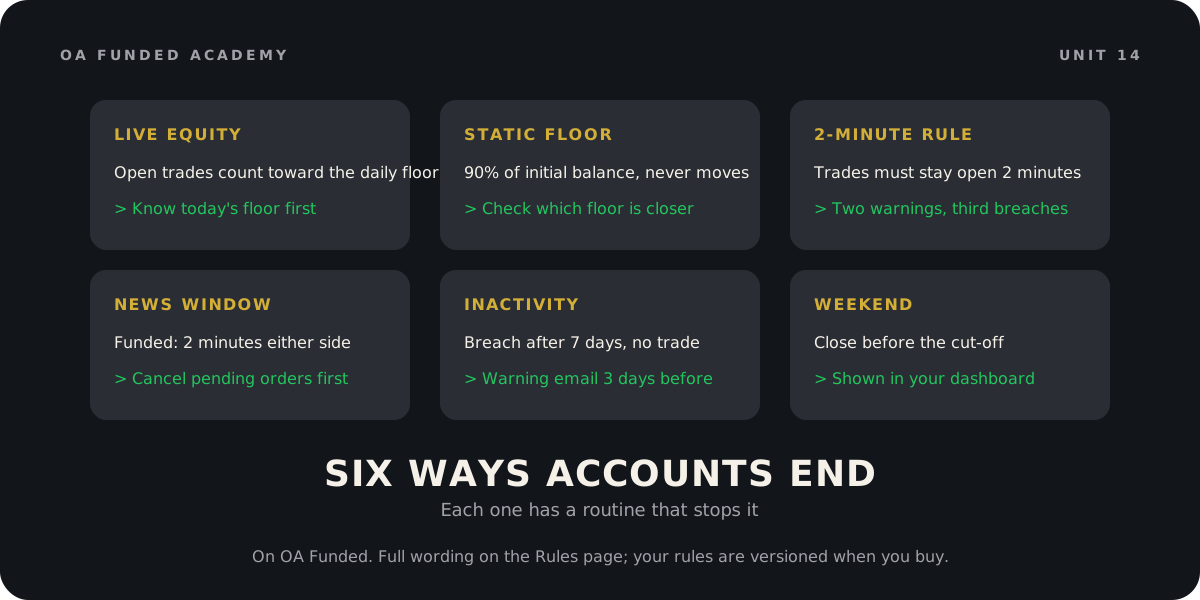
Trap one: the daily loss limit runs on live equity
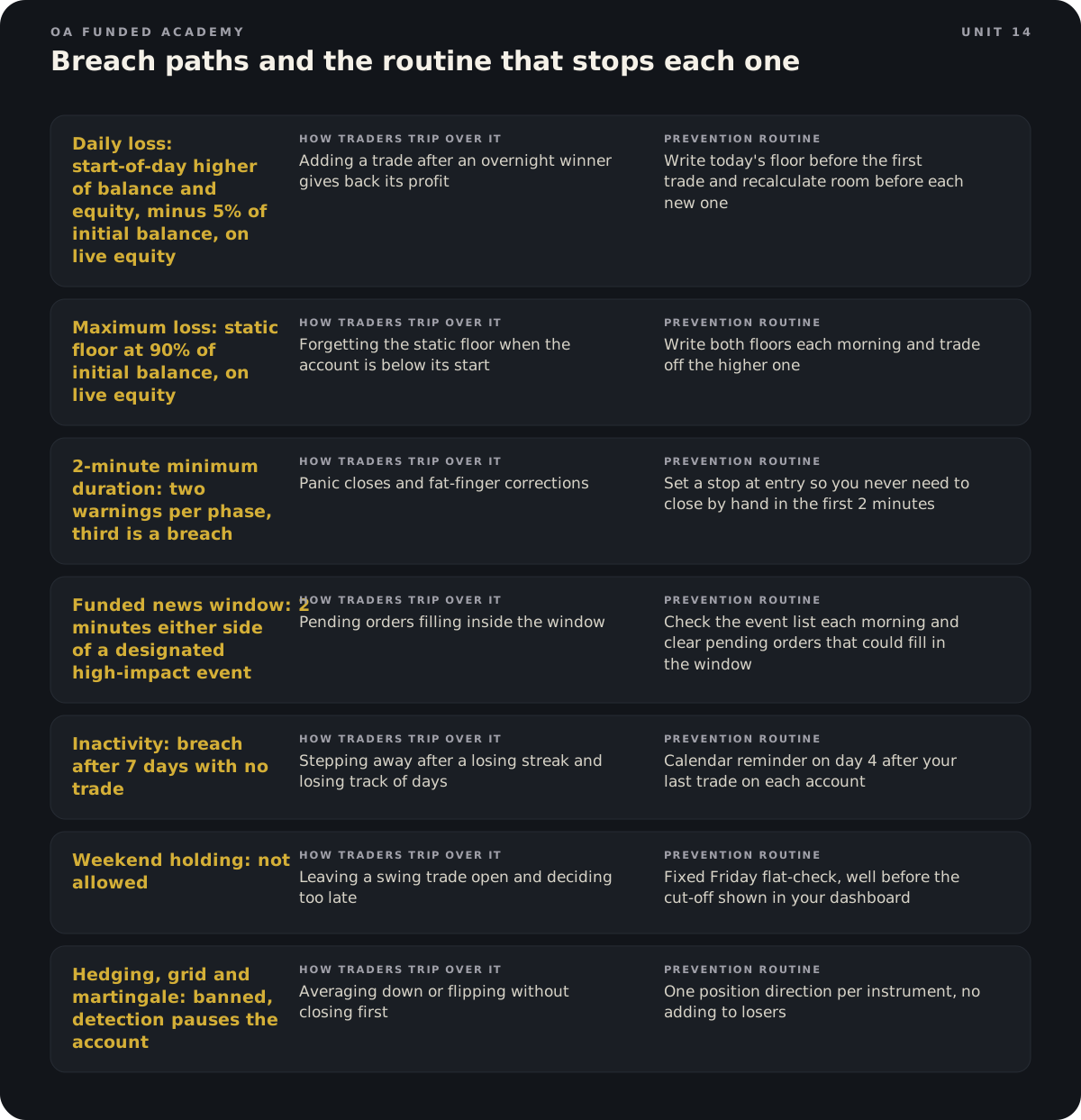
On OA Funded the daily loss limit works like this. At the start of each trading day, we take the higher of your balance and your equity. Take away 5% of your initial balance. That is your floor for the day. If your equity, including open trades, falls below it, the account breaches.
Two words in that rule catch people out. The first is equity. Equity is your balance plus or minus whatever your open trades are doing right now. A losing trade you have not closed still counts. A trade can close flat at the end of the day and still breach the account if it dipped far enough while it was open.
The second is higher. If you hold a winning trade overnight, your start-of-day equity can be higher than your balance. The floor for the new day is then set from that higher number. Floating profit you carried over can lift your floor, and if the trade gives the profit back, you have less room than your balance suggests.
The trading day follows the trading platform's server day. The exact cut-off time is shown in your dashboard. Check it there rather than guessing from your own clock.
Worked example
The overnight winner that shrinks your room
A $10,000 OA Funded account. Balance is $10,000. You are holding a EUR/USD long overnight that is up $300, so equity at the start of the new trading day is $10,300.
- Start-of-day floor: the higher of balance ($10,000) and equity ($10,300) is $10,300.
- 5% of the initial balance is $500. The floor for today is $10,300 minus $500, which is $9,800.
- Mid-morning the long gives back all of its profit. Equity is now $10,000. It feels like you are back to square one with $500 of room.
- You actually have $200 of room: $10,000 equity minus the $9,800 floor.
- You open a second trade with a $250 stop. If both trades go against you at once, equity can fall to $9,750, which is below $9,800. That is a breach, even though your balance never dropped below $10,000 before the day began.
Takeaway: Before any new trade, work out room as current equity minus today's floor. Never use 5% of the account as your room after carrying a winner overnight.
Trap two: the static floor does not care about today
The maximum loss on OA Funded is 10% static. Your equity, including open trades, must stay above 90% of your initial balance. The floor is fixed from day one. It never moves up with your profits. On a $10,000 account, the floor is always $9,000. On a $25,000 account it is $22,500.
Traders who are up rarely think about the static floor. Traders who are down often forget it for a different reason: they are focused on the daily limit. Once your balance has slipped below the starting balance, the static floor can sit above today's daily floor. On that day the static floor is the line that matters, and your real room is smaller than the 5% you have trained yourself to expect.
The fix is one habit. Each morning, write down both floors and circle the higher one. That circled number is your line for the day.
Worked example
When the static floor is closer than the daily floor
A $10,000 OA Funded account after a rough week. Balance and equity at the start of the trading day are both $9,350. No trades are open.
- Daily floor: $9,350 minus $500 (5% of $10,000) is $8,850.
- Static floor: 90% of $10,000 is $9,000. It has not moved.
- The higher of the two is $9,000. That is the real line today.
- Real room is $9,350 minus $9,000, which is $350, not $500.
- If your normal risk is $100 a trade, three straight losers leave you $50 above the floor. Cut size before you start, not after the second loss.
Takeaway: Room for the day equals equity minus the higher of the daily floor and the static floor. Do this sum every morning.
On a $10,000 OA Funded account, the trading day starts with a balance of $10,100 and equity of $10,250 because a trade is open in profit. What is the daily loss floor for that day?
Trap three: rules that warn you first
Two OA Funded rules give you warnings before they breach the account. That is a kindness, and it is also a trap, because traders treat a warning as a free pass.
Minimum trade duration. Every trade must stay open for at least 2 minutes. You get two warnings in each phase (Phase 1, Phase 2 and funded). The third trade closed in under 2 minutes in that phase is a breach. Open at 9:00 AM: do not close before 9:02 AM. The usual way people hit this is not deliberate scalping. It is panic. Price ticks against you ten seconds after entry and you slam the close button. Or you fat-finger a size, close it instantly, and reopen. Both count.
The news window, funded accounts only. News trading is unrestricted during the evaluation. On a funded account, you may not create or increase exposure from two minutes before to two minutes after a designated high-impact event. You can still hold, close or reduce. Your stop loss and take profit can still execute. A pending order that triggers inside the window counts as new exposure. The first trade opened in a window is a warning. The next one is a breach.
Notice the difference in budget. The duration rule gives you two warnings per phase. The news window gives you one. Treat your first warning on either rule as the end of the budget, not the start of it.
You trade a funded OA Funded account. A designated high-impact event is at 8:30 AM. A sell stop you placed at 7:50 AM triggers at 8:29 AM. How is that treated?
Trap four: the quiet rules that end accounts
Inactivity. An account breaches if no trade is taken on it for 7 days. The clock starts when the account is issued. It restarts every time you take a trade on that account. We email you a warning 3 days before the breach. Traders hit this after a bad week when they step away to reset, which is healthy, or when they buy an account and wait for the perfect setup. Taking a break is fine. Just put a reminder in your calendar on day 4 so the warning email is never the first you hear of it.
Weekend holding. Weekend holding is not allowed on OA Funded. Close open positions before the applicable weekend market cut-off. The cut-off will be shown in your dashboard before funded trading is available. Overnight holding during the week is allowed. The trader who gets caught is the one with a swing idea on Thursday who tells themselves they will decide on Friday afternoon, then gets busy.
Banned styles. Hedging of any kind is banned, including opposite positions on a single account and across accounts. Grid trading and martingale are banned too, and the rules page defines both precisely, so read those definitions once. If hedging, grid or martingale trading is detected, we pause trading on the account and review it. A pause is not an automatic breach. You cannot take any trade on a paused account. The simple way to stay clear: one view per instrument at a time, and never add size to a loser to bring your average price back.
Payout problems you can see coming
Some problems do not end the account. They just slow you down, and slow money tempts traders into rushed decisions. Knowing the payout conditions in advance takes that pressure off.
On OA Funded, your first 14-calendar-day cycle starts with your first trade on the funded account. You need at least five traded days in the cycle. You can request a payout once per 14-calendar-day cycle, and each later cycle starts from your last payout payment. The minimum payout is 1% of the account or $100, whichever is higher. Payouts go by bank transfer. Requests are approved in under 48 hours. Your dashboard shows the amount available to request when you meet the payout conditions.
The common delays are all self-inflicted. A trader counts days from when they passed Phase 2, not from their first funded trade. Or they trade on four days and wait for day 14, then realise they are a day short. Or they request less than $100. None of these is a mystery. Put the cycle start date and your traded-day count on a sticky note.
Two more points save a lot of frustration. Evaluation fees are never refundable. That includes when you get a payout, and when identity verification fails. And misrepresenting your identity, ownership, copier setup or who controls the strategy is a prohibited practice, as is sharing credentials or letting a third party manage your account. Buy the account in your own legal name, use details that match your ID, and never let anyone else trade it. If something about your details is unclear, ask support before you start trading. Support hours: Monday to Friday, 10am to 4pm Eastern Time.
The minimum is 1% of the account or $100, whichever is higher, applied to your share. Below it, nothing is lost: it stays owed to you. The other payout conditions (14 days, five traded days) still apply.
A funded OA Funded trader placed their first funded trade 15 calendar days ago. They have traded on 4 separate days and the dashboard shows $340 available. What is missing?
Avoid these
Common mistakes.
Mistake
Treating an open losing trade as harmless until it is closed
Do this instead
Both loss limits on OA Funded run on equity, including open trades. Size every trade so the worst case at your stop keeps equity above the higher floor.
Mistake
Using 5% of the account as daily room after holding a winner overnight
Do this instead
Today's floor is set from the higher of start-of-day balance and equity. Recalculate room as current equity minus that floor.
Mistake
Forgetting the static floor when the account is below its starting balance
Do this instead
Write both floors every morning. The higher one is your line. The static floor never moves.
Mistake
Treating warnings as spare lives
Do this instead
Count your first warning on the duration rule or the funded news window as the end of the budget. Fix the habit that caused it the same day.
Mistake
Leaving pending orders live into a funded news window
Do this instead
Check the event list each morning and clear or move any pending order that could fill from two minutes before to two minutes after a designated event.
Mistake
Stepping away from an account and losing count of days
Do this instead
Set a reminder 4 days after your last trade on each account so the 7-day rule never surprises you.
Mistake
Deciding on Friday afternoon whether to hold over the weekend
Do this instead
Weekend holding is not allowed on OA Funded. Make the Friday flat-check a fixed appointment well before the cut-off in your dashboard.
Mistake
Counting the payout cycle from the day you passed
Do this instead
Your first cycle starts with your first trade on the funded account. Later cycles start from your last payout payment.
Mistake
Expecting the evaluation fee back with a payout
Do this instead
Evaluation fees are never refundable, including when you get a payout and when identity verification fails. Budget for the fee as spent.
Keep the language straight
Quick glossary.
- Balance
- Account value from closed trades only. It does not move while a trade is open.
- Equity
- Balance plus or minus the current profit or loss on open trades. Both OA Funded loss limits are checked against equity.
- Daily loss floor
- On OA Funded, the higher of start-of-day balance and equity, minus 5% of the initial balance.
- Static floor
- On OA Funded, 90% of the initial balance. It is fixed from day one and never moves up with profits.
- Room
- Current equity minus the higher of the daily floor and the static floor. The most you can lose before a breach.
- Breach
- A rule event that ends the account, such as equity falling below a floor.
- Warning
- A recorded rule event that does not end the account yet. On OA Funded the duration rule and the funded news window give warnings first.
- Detection pause
- On OA Funded, a pause on trading while suspected hedging, grid or martingale activity is reviewed. It is not an automatic breach.
- Payout cycle
- On OA Funded, a 14-calendar-day period that must include at least five traded days before a payout request.
Lesson check.
6 questions on the whole unit. Score 80% or more to show you have it.
1.A $25,000 account starts the day flat at $25,600. An open trade is now $900 in loss. You want to add a trade with a $400 stop. What happens if both trades go against you?
2.A $50,000 funded account meets the cycle conditions. The trader's 80% share of the profit available is $480. Can they request a payout?
3.You closed two trades in under 2 minutes during Phase 1 and then passed. In Phase 2 you close a trade after 90 seconds. What happens?
4.On a funded account a designated high-impact event is at 2:00 PM. It is 1:59 PM. Which action is allowed?
5.Which statement about OA Funded's inactivity rule is correct?
6.Your first payout was paid on the 20th. You want to plan your next request. Where does the next cycle start?
Practice room
3 activitiesTurn the idea into a decision.
These are fictional learning scenarios. They never place trades or use real money. Complete the required checks to finish this lesson.
Finish this unit
Pass each required activity, then save the current lesson version to your record.
Public lesson Q&A
Ask what is still unclear.
No published questions yet.
Sources and review
- OA Funded RulesReviewed 2026-10-31Open (opens in a new tab)
- OA Funded FAQReviewed 2026-10-31Open (opens in a new tab)
- MQL5 blog: How to Protect Your Prop Firm Daily Loss LimitReviewed 2026-10-31Open (opens in a new tab)
- Fortunly: How Prop Firm Drawdown Rules Actually WorkReviewed 2026-10-31Open (opens in a new tab)
- BabyPips: Top 7 Reasons Most Funded Traders Fail Their Funded AccountsReviewed 2026-10-31Open (opens in a new tab)