

Unit 13 · 38 min read
Risk Management for Prop Traders.
Size every trade against OA Funded's daily loss floor and static 90% floor, know how many losing trades fit before either one, and plan the 5-day, 3-profitable-day requirement without forcing trades.
- Level
- Intermediate
- Revision
- mentor-2026-10
- Access
- Public
By the end, you can
- Work backward from the daily floor and the static floor to a risk per trade
- Calculate how many full losing trades fit before each floor on a $10K and a $25K account
- Explain why normal losing streaks are longer than most traders expect
- Set a personal daily stop and behaviour stops that trigger before any OA rule
- Plan the minimum trading days without lowering your standards
Start from the floor and work backward
Most traders choose risk per trade the wrong way round. They look at the target, decide how fast they want to get there, and pick a size that gets them there quickly. Then the first losing streak arrives and the size that looked fine is suddenly far too big.
On a prop account you do it the other way. You start from the lines you cannot cross, work out how many losses you need to survive, and only then pick a size. The target comes last.
On OA Funded there are two lines. The daily loss floor is the higher of your start-of-day balance and equity, minus 5% of your initial balance. The maximum loss floor is static: your equity, including open trades, must stay above 90% of your initial balance, and it never moves. Both are checked against equity, so floating losses count.
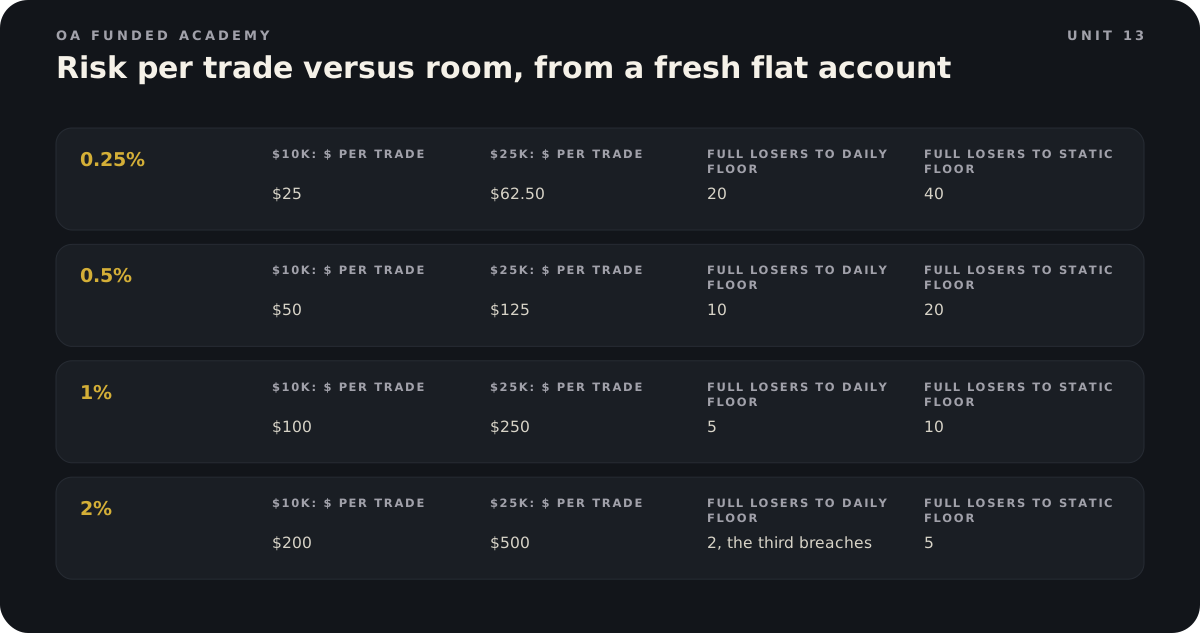
In dollars: a $10K account has a daily allowance of $500 and a static floor of $9,000. A $25K account has a daily allowance of $1,250 and a static floor of $22,500. Everything in this unit is built on those four numbers.
Worked example
How many losers fit? ($10K)
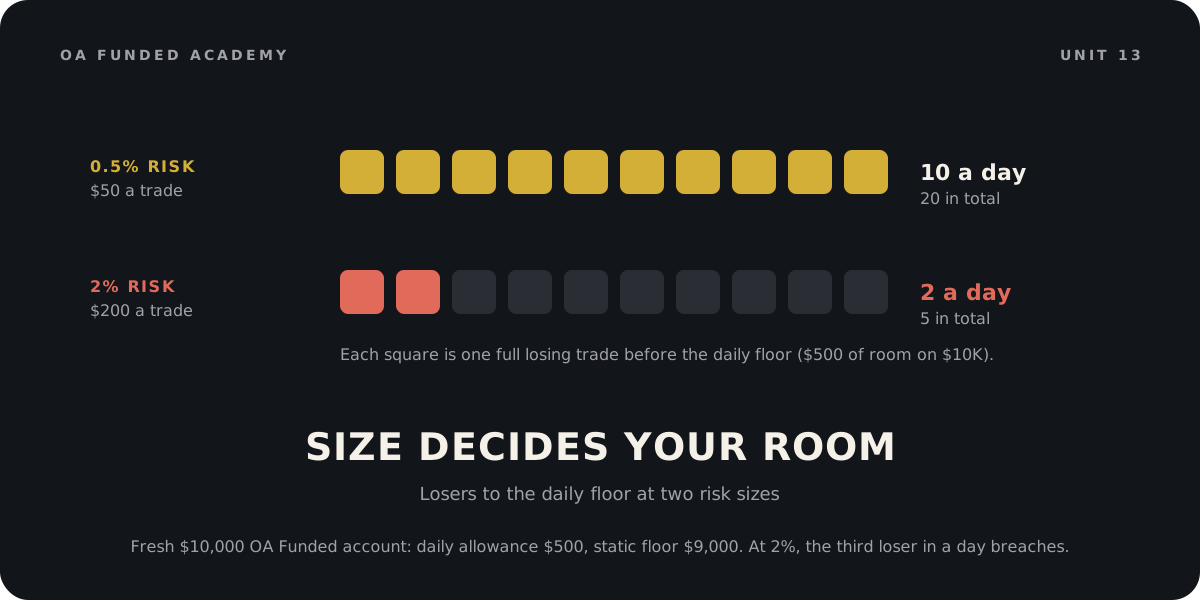
A fresh $10K account, flat, at $10,000. Daily allowance $500. Static floor $9,000, which is $1,000 away. The trader risks 0.5% of the initial balance per trade: $50.
- Losers to the daily floor: $500 divided by $50 = 10 full losing trades in one day.
- Losers to the static floor: $1,000 divided by $50 = 20 full losing trades in total.
- Now allow for reality. Spread, slippage and a stop that fills a few pips worse can turn a $50 loss into $55 or $60. Plan on using no more than about 80% of the gap. That gives 8 losers per day and 16 in total.
- Now compare 2% risk ($200). Daily floor: 2 full losers, and the third breaches. Static floor: 5 losers in total. One normal bad day can end the account.
Takeaway: At 0.5% risk the account can absorb a normal losing streak. At 2% it cannot.
Worked example
The same maths on $25K
A fresh $25K account, flat, at $25,000. Daily allowance $1,250. Static floor $22,500, which is $2,500 away. The trader risks 0.4% of the initial balance per trade: $100.
- Losers to the daily floor: $1,250 divided by $100 = 12 full losers, or about 10 after allowing for slippage.
- Losers to the static floor: $2,500 divided by $100 = 25 full losers, or about 20 after allowing for slippage.
- Personal daily stop: the trader stops after 4 losers ($400) in a day. That is less than a third of the daily allowance, so even a bad fill on the last trade leaves a wide margin.
- After a drawdown to $23,500, the static floor is only $1,000 away. At $100 risk that is 10 losers, not 25. The trader halves risk to $50 until the account is back above $24,000.
Takeaway: Your room is not fixed. Recalculate it every morning, and cut risk when the static floor gets closer.
Losing streaks are longer than you think
Here is the part traders underestimate. If your setups win half the time, it feels like losses should alternate with wins. They do not. Over 100 independent trades with a 50% win rate, the chance of seeing at least one run of 5 losses in a row is about 81%. A run of 6 is about 55%. A run of 8 is about 17%.
With a 40% win rate, which is normal for many trend and breakout styles with bigger winners, the numbers get worse: about 87% for a run of 6 and about 49% for a run of 8 over 100 trades.
Put that next to the table above. At 1% risk on a fresh $10K account, a run of 5 losers in one day reaches the daily floor and a run of 10 reaches the static floor. Those streaks are not bad luck. They are expected over a few months of trading.
This is why I keep risk between a quarter and a half of a percent on prop accounts, and why I would ask you to start there. It is not caution for its own sake. It is sizing so that a streak you should expect cannot end the account.
A trader with a 45% win rate risks 1% per trade on a fresh $10K account. Which statement is most accurate?
Open trades, carried trades and the moving start line
Because the daily floor starts from the higher of balance and equity at the start of the day, carrying a trade across the day boundary changes your floor. The trading day follows the trading platform's server day, and the exact cut-off time is shown in your dashboard.
Carry a winner, and equity is higher than balance, so the floor is set from equity. If the trade then gives back its open profit, that giveback comes out of today's allowance. Carry a loser, and balance is higher, so the floor is set from balance, but your equity starts the day closer to it.
None of this means you cannot hold overnight. Overnight holding during the week is allowed. It means you should decide before the cut-off what you are carrying and what that does to tomorrow's floor.
Worked example
The carried winner ($10K)
Balance $10,000. One GBP/USD trade is open with $400 of floating profit when the server day rolls over, so equity is $10,400.
- Start-of-day figure: the higher of $10,000 and $10,400 is $10,400.
- Daily floor: $10,400 - $500 = $9,900.
- The trade reverses back to break-even. Equity is $10,000, only $100 above the floor, and you have not opened anything new today.
- If you then take your normal $50 trade and it loses, equity is $9,950, only $50 above the floor, after a single new trade on a day you thought had a full $500 of room.
- Options before the cut-off: close part of the trade to bank some profit, tighten the stop so the giveback is capped, or accept the risk and plan to take no new trades the next day until the carried trade is resolved.
Takeaway: Open profit at the day boundary becomes part of tomorrow's start line. Decide what you carry on purpose.
Leverage and the all-in rule
OA Funded offers leverage up to 1:50, depending on the instrument. Leverage decides how big a position the platform lets you open for the margin you have. It does not decide how much you should risk. Your stop distance and your risk per trade decide that.
Here is why it matters. At 1:50, a $10K account could open roughly $500,000 of notional exposure if margin allowed it. A 0.2% move against that would be $1,000, which is the whole distance to the static floor. The platform letting you open a position is not the same as the account being able to survive it.
The OA Rules page also lists, under prohibited practices, all-in position sizing that puts a disproportionate share of your account equity at risk in one trade or series of trades. Sizing from the floors, as in this unit, keeps you far away from that line.
Personal limits that trigger before the rules do
Your own limits should always trigger before OA's. If the first stop you ever hit is the firm's floor, you have no plan, only a boundary.
Set three kinds of stop. A daily dollar stop, such as 2 to 4 losing trades or about a third to a half of the daily allowance. A weekly dollar stop, such as 3% of the initial balance, after which you trade at half size until you are back above it. And behaviour stops: you stop for the day after you break one of your own rules, move a stop loss further away, or feel the urge to win a loss back.
That last one is the one that saves accounts. After two or three losers, most traders feel a pull to take the next setup bigger, or to take a setup that is not really there. That is the revenge urge, and it does not feel like revenge from the inside. It feels like confidence. Write the rule down: after my daily stop, I close the platform. Then get up and walk away from the screen. Come back tomorrow and recalculate your floors before your first trade.
Planning the 5 trading days without forcing trades
On OA Funded you need at least 5 trading days in each phase, and at least 3 of them need a net realised profit of at least 0.5% of the initial balance. A day counts when you close a trade on that day. There is no time limit.
That rule pulls traders into two bad habits. The first is forcing: taking a weak setup on a quiet day because you want the day to count. The second is chasing the 0.5%: holding a small winner too long, or adding a second trade, to push a day over the line. Both put your normal risk rules second to a box you want ticked.
The fix is to stop thinking of the rule as a daily task. It is a minimum count over a phase with no deadline. If you trade your plan on the days your setups appear, the days will come. If your setups appear rarely, it will take longer, and that is allowed.
There is one situation that needs a plan. Sometimes you reach the profit target before you have 5 trading days or 3 qualifying days. Do not size up to make the remaining days big. Keep trading your normal setups at your normal risk, or lower, and accept that some of those days may lose. Every trade still has to stay open at least 2 minutes, and your floors still apply.
Worked example
Target reached early ($25K, Phase 2)
Phase 2 on a $25K account. Target: closed balance of $26,250 with nothing open. After 3 trading days the closed balance is $26,400. Two of those days had 0.5%+ net realised profit (of the initial balance).
- Still needed: at least 2 more trading days, and at least 1 more qualifying day, to reach 5 days with 3 qualifying.
- The cushion above the target is $150. A normal $100 loser keeps the balance above $26,250; two would not. So the trader cuts risk to $50 per trade for the remaining days.
- Day 4: one setup, closes up about $180. Qualifying day number 3. Closed balance about $26,580.
- Day 5: one setup, closes down $50. That still counts as a trading day because a trade was closed. Five trading days, three qualifying, closed balance about $26,530 with nothing open.
- At no point did the trader take a setup that was not in the plan.
Takeaway: When the target comes early, protect it with smaller risk and keep trading only real setups until the day count is met.
On OA Funded, which day counts toward the 5 trading days?
You need one more qualifying day. Today there is no setup that meets your plan. What is the best action?
Avoid these
Common mistakes.
Mistake
Choosing risk per trade from how fast you want to reach the target
Do this instead
Start from the daily floor and static floor, decide how many losers you must survive, then size.
Mistake
Assuming a 50% win rate means losses alternate with wins
Do this instead
Over 100 trades at 50%, a run of 5 losses in a row is more likely than not. Size for it.
Mistake
Treating correlated trades as separate risks
Do this instead
Add up the risk of every open trade that shares a currency in the same direction.
Mistake
Carrying a big open winner over the day boundary without a plan
Do this instead
Open profit at the start of the day raises the daily floor. Bank part of it, tighten the stop, or plan a lighter next day.
Mistake
Keeping the same risk after a drawdown
Do this instead
The static floor does not move, so your room shrinks. Recalculate and cut risk.
Mistake
Using leverage as a sizing guide
Do this instead
Leverage up to 1:50 only sets what the platform allows. Size from your stop distance and risk per trade.
Mistake
Forcing trades or pushing days over 0.5% to meet the trading-day count
Do this instead
There is no time limit. Trade only real setups and let the count build.
Keep the language straight
Quick glossary.
- Risk per trade
- The dollar amount you lose if a trade hits its stop loss, usually set as a percentage of the account.
- Daily allowance
- On OA Funded, 5% of the initial balance: the distance from the start-of-day figure to the daily floor.
- Losing streak
- A run of consecutive losing trades. Long streaks are normal over many trades.
- Correlated exposure
- Several open positions that move together because they share a currency or a driver.
- Personal daily stop
- Your own loss limit for the day, set well inside the firm's floor.
- Leverage
- The ratio of position size to margin the platform allows. On OA Funded, up to 1:50 depending on the instrument.
- Slippage
- The difference between the price you expected and the price you got.
- Notional exposure
- The full market value of a position, not just the margin used to open it.
Lesson check.
6 questions on the whole unit. Score 80% or more to show you have it.
1.A $25,000 OA Funded account starts the trading day with balance and equity both at $23,000 and nothing open. You normally risk $125 a trade. How many full losers can you take before equity reaches the line that matters today?
2.On a $10,000 account your balance is $10,000 and a trade carried overnight is $250 in profit when the server day rolls over. Later that morning the same trade is $100 in loss. How much room is left before today's daily floor?
3.You trade a $10,000 account at $50 risk per trade. Which personal daily stop fits the approach in this unit?
4.You are long EUR/USD, long GBP/USD and short USD/JPY, risking $60 on each. Your personal daily stop is $150. What is the honest read of your position?
5.OA Funded offers leverage up to 1:50, depending on the instrument. What should decide how much you risk on a trade?
6.Phase 1 on a $10,000 account. After 3 trading days your closed balance is $10,850 with nothing open, and 2 of those days had at least 0.5% net realised profit. What still has to happen on the trading-day rule?
Practice room
3 activitiesTurn the idea into a decision.
These are fictional learning scenarios. They never place trades or use real money. Complete the required checks to finish this lesson.
Finish this unit
Pass each required activity, then save the current lesson version to your record.
Public lesson Q&A
Ask what is still unclear.
No published questions yet.
Sources and review
- OA Funded Trading RulesReviewed 2026-10-31Open (opens in a new tab)
- OA Funded FAQReviewed 2026-10-31Open (opens in a new tab)
- Babypips: Calculating Your Position SizeReviewed 2026-10-31Open (opens in a new tab)
- MQL5: Building a Trading System (Part 2): The Science of Position SizingReviewed 2026-10-31Open (opens in a new tab)
- Fortunly: How Prop Firm Drawdown Rules Actually WorkReviewed 2026-10-31Open (opens in a new tab)
- Chat With Traders 065: Brett Steenbarger on trading psychologyReviewed 2026-10-31Open (opens in a new tab)