

Unit 12 · 32 min read
OA Plans and the Evaluation Journey.
Follow the OA Core Two-Step from choosing an account size, through Phase 1 and Phase 2, identity verification and the funded account, to your first payout cycle, with a plan for each stage.
- Level
- Beginner
- Revision
- mentor-2026-10
- Access
- Public
By the end, you can
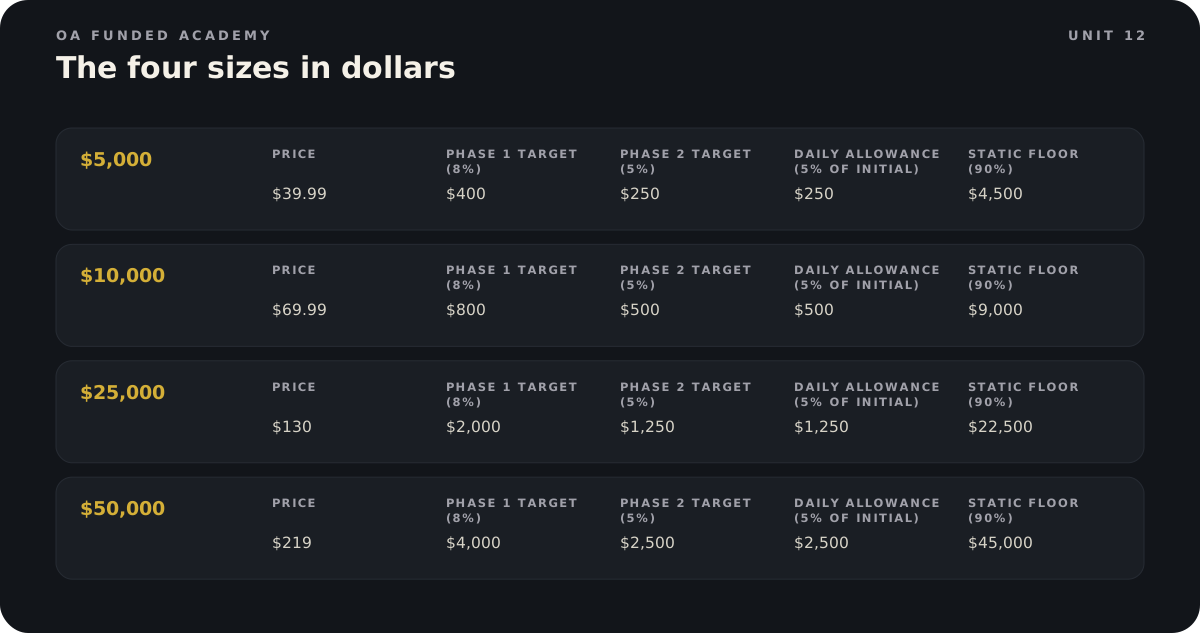
- Compare the four OA account sizes by price, dollar targets and dollar floors
- Choose a size based on fee comfort and risk granularity, not headline balance
- Plan Phase 1 and Phase 2 around the minimum trading days with no deadline pressure
- Describe what changes on the funded account, including the news window
- Lay out the first 14-calendar-day payout cycle and its conditions
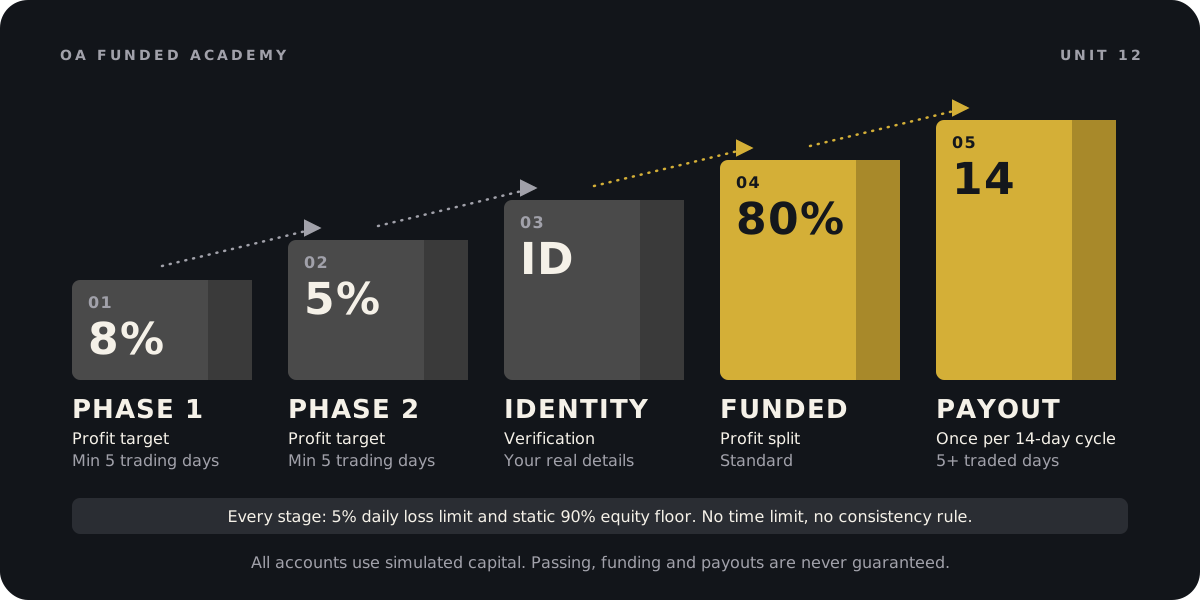
The whole journey on one page
OA Funded runs a simulated-capital evaluation. At launch there is one product, the OA Core Two-Step. Every account, evaluation and funded, uses simulated capital. Your evaluation fee pays for access to the evaluation service.
The path has five stages. You choose a size and pay. You pass Phase 1 with an 8% target. You pass Phase 2 with a 5% target. You complete identity verification. Then your funded account follows in under 3 business days, and you work toward your first payout cycle.
Each stage has its own trap. Choosing a size, the trap is ego. Phase 1, it is speed. Phase 2, it is freezing near the line. Funded, it is changing how you trade. Payout, it is not knowing the calendar. We will take them one at a time.
Nothing in this unit is a forecast. Passing is never guaranteed, and neither is funding or a payout. What you can control is how you prepare, how you size, and whether you stop when your plan says stop.
Choosing a size: three questions
Prices are in US dollars. There is no activation fee after you pass. There is no $100K account.
Every size runs the same rules as a percentage. The 8% and 5% targets, the 5% daily loss limit and the 10% static maximum loss are the same on $5K and $50K. A bigger account does not make the rules easier. It only makes every dollar figure bigger, both the wins and the losses.
So ask three questions. First: could I lose this fee without it changing how I trade? Evaluation fees are never refundable. If losing the fee would make you trade scared or trade angry, pick a smaller size. Fear of losing the fee is one of the most common reasons traders force trades.
Second: does this size let me risk what my plan says? If your plan risks 0.5% per trade, that is $25 on $5K, $50 on $10K and $125 on $25K. On a small account with a wide stop, you may not be able to size down far enough. Run your normal stop distance through a position size calculator for each size and check the lot size makes sense.
Third: have I already traded my plan on a demo or small account for long enough to know my normal losing streak? If not, the size question is premature. Start there.
What you should not ask is: which size makes the biggest payout? That question leads to sizing up beyond your skill, and the account does not care how much you wanted it.
Worked example
Same trader, two sizes ($10K and $25K)
A trader risks 0.5% of the initial balance per trade, with a 20-pip stop on EUR/USD, where one standard lot is worth about $10 per pip.
- $10K account: 0.5% is $50. $50 divided by 20 pips is $2.50 per pip, about 0.25 lots. Phase 1 target: $800. Daily allowance: $500, which is 10 full losing trades.
- $25K account: 0.5% is $125. $125 divided by 20 pips is $6.25 per pip, about 0.62 lots. Phase 1 target: $2,000. Daily allowance: $1,250, which is also 10 full losing trades.
- As percentages, both accounts are identical. The trade count to the target, the number of losers to the floor and the edge needed are the same.
- The difference is emotional. A $125 loser feels heavier than a $50 loser. If a $125 loss would make you want to win it back immediately, the $25K account is the wrong size for you today.
Takeaway: Size does not change the maths of passing. It changes how each loss feels, so pick the size whose losses you can take calmly.
Phase 1: the 8% target with no clock
Phase 1 asks you to make 8% profit, measured on your closed balance with no open positions. You need at least 5 trading days, and at least 3 of them need a net realised profit of at least 0.5% of the initial balance. There is no time limit and no consistency rule.
Read that again: no time limit. The pressure you feel in Phase 1 is coming from you, not the rulebook. Traders in prop firm forums describe the same pattern over and over. They buy an evaluation, feel they need to pass this week, size up after two losers, and breach on day four. Nobody asked them to finish this week.
The two clocks that do exist are small. The inactivity rule breaches an account if no trade is taken on it for 7 days. And the server day, which the trading day follows, decides when your daily floor resets. Neither one asks you to hurry.
A healthy Phase 1 looks boring. You trade your normal setups at your normal risk, stop for the day at your personal daily stop, and log every trade. If the 8% takes three weeks, it takes three weeks.
Worked example
A Phase 1 that takes its time ($10K)
$10K account, risk $50 per trade, personal daily stop of two losers ($100). Target: closed balance of $10,800 with no open trades. Need 5 trading days with at least 3 at 0.5%+ net realised profit (of the initial balance).
- Week 1: trades on 4 days. Two days close up about $120 each, one closes down $100 at the personal stop, one is flat. Closed balance $10,140. Two qualifying days so far.
- Week 2: no clean setups on Monday or Tuesday, so no trades. That is allowed. On Wednesday a small trade is taken. The inactivity clock restarted with every trade, so there is no risk.
- Week 2 continued: two more days close up about $150 and $200. Closed balance about $10,480. Four qualifying days, six trading days.
- Week 3: the account reaches a closed balance of $10,810 with nothing open. Trading days and qualifying days are already met. Phase 1 is complete.
- None of these weeks needed more than the planned $50 risk per trade.
Takeaway: Skipping days without a setup is part of the plan. The rule asks for 5 trading days, not 5 days in a row.
You are 4 days into Phase 1, down $150 on a $10K account. What does the rulebook require you to do?
Phase 2: smaller target, same floors
Phase 2 asks for 5% profit, measured the same way, on your closed balance. The Rules page example for a $10K account is closing out at $10,500 or more with no open trades. The minimum trading days are the same: at least 5, with at least 3 at 0.5%+ net realised profit (of the initial balance). The daily loss limit and the static floor work exactly as before.
Phase 2 has its own warnings for the 2-minute rule. You get two warnings in each phase, and the count is per phase.
The target is smaller, so many traders expect Phase 2 to be easy. It often feels harder. You passed once, so now you have something to lose. That feeling shows up as freezing: skipping valid setups, closing winners at a few pips, or moving stops to break-even too early. Or it shows up the other way, as forcing: taking marginal trades to get it over with.
Both come from the same place. You are trading the outcome, not the setup. The fix is the same routine you used in Phase 1, with one addition for when you get close.
Identity verification and the funded account
After you pass Phase 2, you complete identity verification. Once you have passed and completed identity verification, your funded account follows in under 3 business days.
Two things to know. Evaluation fees are not refunded if identity verification fails, so make sure the details you buy under are your real details. And misrepresenting your identity, ownership, copier setup or who controls the strategy is a prohibited practice. The person who passes is the person who trades.
Use the waiting days well. Review your Phase 1 and Phase 2 journal. Write down what your average loss, your worst day and your longest losing streak were. Those are the numbers you will plan the funded account around.
What changes when you are funded
The FAQ answers this directly. The same 5% daily loss limit and static 90% equity floor apply on the funded account. There is no time limit and no consistency rule. You need at least five traded days in each payout cycle.
One rule is new. On a funded account, you may not create or increase exposure from two minutes before to two minutes after a designated high-impact event. You can still hold, close or reduce. A pending order that triggers inside the window counts as new exposure. The first trade opened in a window is a warning. The next one is a breach. If you traded news freely during the evaluation, this is the habit to change on day one.
The 2-minute minimum trade duration also gets a fresh count: two warnings in the funded phase, and the third short trade in that phase is a breach.
Funded traders keep 80% of profits as standard. The account is still simulated capital.
The biggest risk on a funded account is not a rule. It is the urge to trade differently. Traders who pass often size up because it finally feels real, or freeze because they do not want to lose it. Your funded plan should look like your evaluation plan. If it worked, it does not need changing because the label did.
Worked example
Mapping the first payout cycle ($25K funded)
A funded account with a $25,000 initial balance. The FAQ says your first 14-calendar-day cycle starts with your first trade on the funded account, and you need at least five traded days in the cycle.
- The account is issued on a Thursday. You take no trade that day, so the cycle has not started. The inactivity clock has, because it starts when the account is issued.
- Monday: first trade on the funded account. Day 1 of the first 14-calendar-day cycle. Count 14 calendar days, weekends included.
- Over the 14 days you trade on 6 days. That meets the five traded days requirement.
- Once you meet the payout conditions, your dashboard shows the amount available to request. The minimum payout is 1% of the account or $100, whichever is higher: $250 on this $25,000 account. Payouts are paid by bank transfer, and requests are approved in under 48 hours.
- After the payout, your balance is reduced by the profit paid out. The static floor stays at $22,500, so your cushion is smaller. The next cycle starts from your last payout payment.
Takeaway: Write the cycle start date in your journal the day you take your first funded trade, and count traded days as you go.
When does your first payout cycle start on OA Funded?
Which rule applies on the funded account but not during the evaluation?
Avoid these
Common mistakes.
Mistake
Choosing the biggest account to get the biggest payout
Do this instead
Every size has the same percentage rules. Choose the size whose fee and losses you can take calmly.
Mistake
Treating Phase 1 like a race
Do this instead
There is no time limit. Trade only when your setups appear, and keep at least one trade every 7 days.
Mistake
Trying to win the evaluation fee back quickly
Do this instead
Evaluation fees are never refundable. Treat the fee as the cost of the attempt.
Mistake
Freezing or forcing near the Phase 2 target
Do this instead
Use the near-target routine: write the trade first, keep normal risk, and close by plan.
Mistake
Trading news the same way on a funded account
Do this instead
On a funded account, no new or increased exposure from two minutes before to two minutes after a designated high-impact event. Pending orders count.
Mistake
Thinking the payout cycle starts when the account is issued
Do this instead
It starts with your first trade on the funded account. The inactivity clock, however, starts at issue.
Mistake
Forgetting the floor after a payout
Do this instead
After a payout your balance is reduced by the profit paid out and the static floor stays the same. Re-plan your risk.
Keep the language straight
Quick glossary.
- OA Core Two-Step
- OA Funded's two-phase simulated-capital evaluation, and the only product at launch.
- Phase 1
- The first stage of the OA Core Two-Step, with an 8% profit target.
- Phase 2
- The second stage, with a 5% profit target.
- Funded account
- The simulated-capital account you trade after passing Phase 2 and identity verification.
- Identity verification
- The check that confirms the person who passed is who they say they are, before the funded account is issued.
- Payout cycle
- On OA Funded, a 14-calendar-day period. The first starts with your first funded trade; later ones start from your last payout payment.
- Profit split
- The share of profits the trader keeps. On OA Funded it is 80% as standard.
- Evaluation fee
- The one-time price of an evaluation. It pays for access to the evaluation service and is not refundable.
Lesson check.
6 questions on the whole unit. Score 80% or more to show you have it.
1.A trader always risks 0.5% of the initial balance per trade. They are choosing between the $5,000 account ($39.99) and the $50,000 account ($219). How many full losing trades fit inside the 5% daily allowance on each?
2.On a $25,000 funded account, your dashboard shows $220 available to request as your share. What is true about the minimum payout?
3.In your first 14-calendar-day payout cycle on a funded account, you traded on Monday, Tuesday and Thursday of the first week and Wednesday of the second week. Have you met the traded-days condition for the cycle?
4.Your funded account is issued on a Thursday. You take your first trade on it the following Tuesday, 5 days later. Which statement is correct?
5.Which way of thinking about the evaluation fee matches OA Funded's terms and helps your trading?
6.In Phase 1 you received two warnings for closing trades in under 2 minutes. You then pass into Phase 2, and on your first day you close a trade after 70 seconds. What happens?
Practice room
3 activitiesTurn the idea into a decision.
These are fictional learning scenarios. They never place trades or use real money. Complete the required checks to finish this lesson.
Finish this unit
Pass each required activity, then save the current lesson version to your record.
Public lesson Q&A
Ask what is still unclear.
No published questions yet.
Sources and review
- OA Funded Trading RulesReviewed 2026-10-31Open (opens in a new tab)
- OA Funded FAQReviewed 2026-10-31Open (opens in a new tab)
- Babypips: Calculating Your Position SizeReviewed 2026-10-31Open (opens in a new tab)
- Chat With Traders 065: Brett Steenbarger on trading psychologyReviewed 2026-10-31Open (opens in a new tab)