

Unit 11 · 35 min read
OA Rules in Plain English.
Walk through every rule of the OA Core Two-Step with a $10K and a $25K worked example, so you can check any trade against the rulebook before you place it.
- Level
- Beginner
- Revision
- mentor-2026-10
- Access
- Public
By the end, you can
- Calculate the daily loss floor and the static maximum loss floor on a $10K and a $25K account
- Explain why profit targets are measured on closed balance with no open positions
- Count trading days and profitable days correctly for each phase
- Apply the 2-minute minimum trade duration and the funded-only news window
- Recognise the prohibited styles and practices before they become a problem
Read the rulebook like a trader, not a lawyer
Most traders who breach an evaluation did not break a rule they disagreed with. They broke a rule they misunderstood. They read a number, filled in the details from another firm they used to trade with, and found out the difference live.
So this unit has one job. You will walk every rule on the OA Funded Rules page, see it applied to a $10K account and a $25K account, and finish able to answer the questions traders actually ask. Those questions come straight from the OA Funded FAQ.
Two things to keep in mind before we start. First, the Rules page is the source of truth. If this lesson and the Rules page ever disagree, the Rules page wins and you should tell support. Second, on OA Funded your rules are versioned when you buy, and OA makes no retroactive adverse changes. The rules you bought under are the rules you trade under.
Some details live in your dashboard, not in the rulebook. The trading day follows the trading platform's server day, and the exact cut-off time is shown in your dashboard. The weekend cut-off will also be shown in your dashboard before funded trading is available. When a lesson says check your dashboard, that is why.
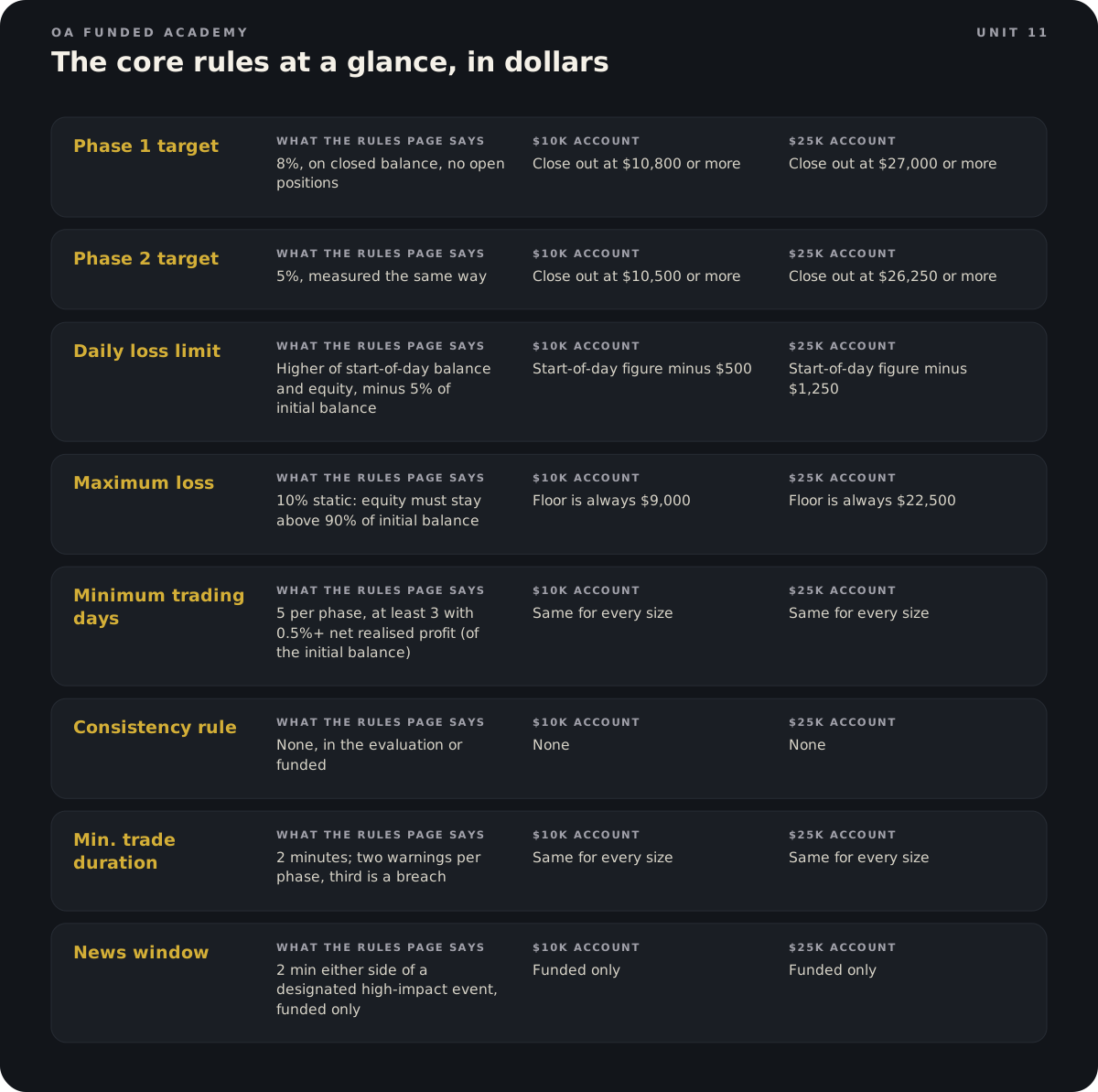
Profit targets: closed balance, flat book
Phase 1 asks for 8% profit. Phase 2 asks for 5%. The Rules page says the target is measured on your closed balance and only counts when you have no open positions.
The FAQ question traders ask is: how is the profit target measured? The answer is: on your closed balance. A target counts only when no positions are open.
In practice this means the number that matters is the balance after your last trade closes, not the floating equity you see while a trade is running. A trade showing $300 in open profit has not earned you anything toward the target yet. It earns it when you close it.
This catches traders in one specific way. They get close to the target, open one more trade, watch equity cross the line and relax. Then the trade turns, and they close below the target. Equity crossing the line means nothing. Closed balance crossing the line, with nothing open, is the only finish line.
Worked example
The target that was not hit yet ($10K, Phase 1)
Phase 1 on a $10K account. The target is a closed balance of $10,800 or more with no open trades. Closed balance is $10,720 and one EUR/USD trade is open with $140 in floating profit.
- Equity is $10,720 + $140 = $10,860. That is above $10,800, but a position is open, so the target has not counted.
- Option A: close the trade at +$140. Closed balance becomes $10,860 with nothing open. The Phase 1 target is met.
- Option B: hold for more. Price reverses and you close at -$60. Closed balance is $10,660. You are $140 short of the target.
- Either way, the target only counts once the book is flat and the closed balance is $10,800 or higher. You still also need the minimum trading days.
Takeaway: Equity over the line is a feeling. Closed balance over the line with no open positions is the rule.
The daily loss limit, step by step
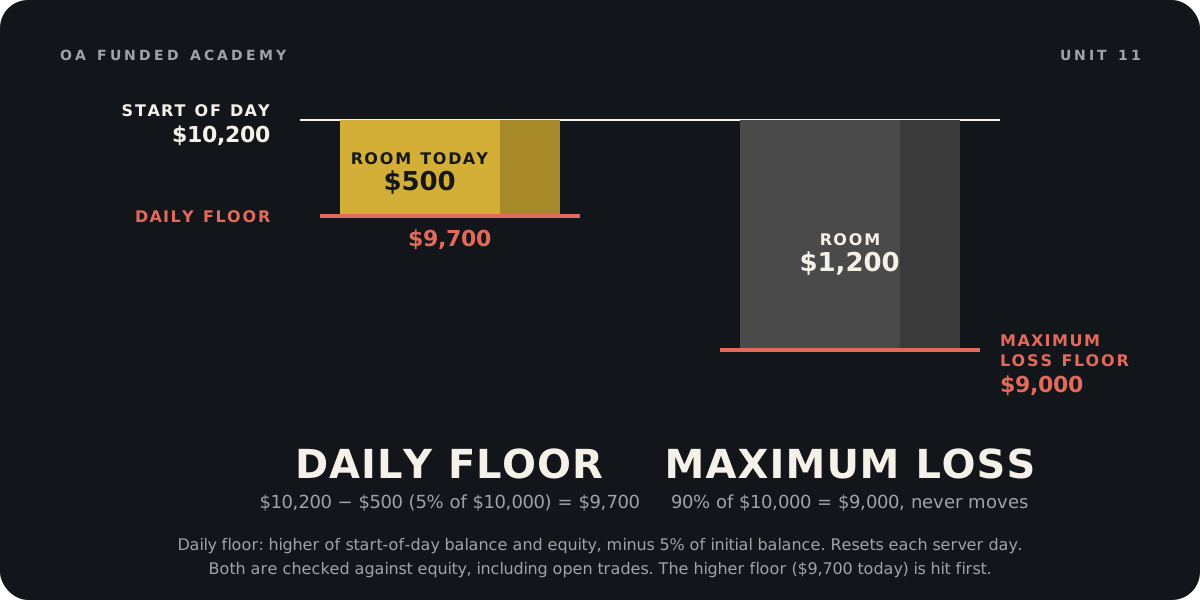
This is the rule traders misread most, so slow down here. The Rules page says: at the start of each trading day, we take the higher of your balance and your equity. Take away 5% of your initial balance. That is your floor for the day. If your equity, including open trades, falls below it, the account breaches.
Break that into three parts. One: the starting figure is whichever is higher at the start of the day, your balance or your equity. If you carried a winning trade over the day boundary, equity is higher, so equity is used. If you carried a losing trade, balance is higher, so balance is used. Two: you subtract 5% of your initial balance, not 5% of today's balance. On a $10K account that is always $500. On a $25K account it is always $1,250. Three: the floor is checked against equity, including open trades, all day. You do not have to close a losing trade to breach. Floating losses count.
The trading day follows the trading platform's server day. The exact cut-off time is shown in your dashboard. Write that time down before your first trade so you know when the floor resets.
Worked example
Three mornings on a $25K account
Initial balance $25,000, so 5% of initial balance is $1,250. The floor for the day is the higher of start-of-day balance and equity, minus $1,250.
- Morning 1: no open trades, balance $25,600. Balance and equity are both $25,600. Floor for the day: $25,600 - $1,250 = $24,350.
- Morning 2: balance $25,600, and you carried a trade that is up $300, so equity is $25,900. The higher figure is equity. Floor: $25,900 - $1,250 = $24,650. If that carried trade gives back its $300 and then loses more, your room shrinks fast.
- Morning 3: balance $25,600, and you carried a trade that is down $200, so equity is $25,400. The higher figure is balance. Floor: $25,600 - $1,250 = $24,350. Equity starts the day only $1,050 above the floor, because the open loser already used $200 of room.
- In all three mornings the floor is checked against live equity. A floating loss that pushes equity below the floor breaches the account even if you planned to hold.
Takeaway: Know your floor number before the first trade of the day, and remember that carried trades change it.
A $10K account starts the trading day with a balance of $10,200 and no open trades. What is the daily loss floor?
Maximum loss: a floor that never moves
The second floor is the maximum loss. The Rules page says your equity, including open trades, must stay above 90% of your initial balance. The floor is fixed from day one. It never moves up with your profits.
On a $10K account the floor is always $9,000. On a $25K account it is always $22,500. If you grow the $10K account to $10,700, the floor is still $9,000, so your cushion has grown to $1,700. That is the good side of a static floor: profit makes your room bigger.
Both floors apply at the same time. On any given day, whichever floor is higher is the one you would hit first. When the account is up, the daily floor is usually the closer one. When the account is down a lot, the static floor can be closer than the daily floor, and that is where traders get surprised.
One more FAQ question: how do payouts affect the floor? After a payout, your balance is reduced by the profit paid out. Your static equity floor stays the same. So after a payout your cushion above the floor gets smaller again. Plan your risk off the new balance, not the old one.
Worked example
When the static floor is the closer one ($10K)
A $10K account has had a rough week. It starts the day with balance and equity both at $9,300 and no open trades.
- Daily floor: $9,300 - $500 = $8,800.
- Maximum loss floor: always $9,000.
- The higher floor is $9,000, so that is the one equity would hit first. Your real room today is $9,300 - $9,000 = $300, not $500.
- If you normally risk $100 per trade, three losers in a row would take equity to $9,000. That is not a plan, that is a coin toss with the account.
Takeaway: Always check both floors. After a drawdown, the static floor can leave you less room than the daily limit suggests.
Trading days, time limits and the inactivity clock
The Rules page says you need at least 5 trading days in each phase. At least 3 of them need a net realised profit of at least 0.5% of the initial balance. A day counts when you close a trade on that day. Net means after costs, and realised means closed trades only. Track each day in your journal so you always know where you stand.
There is no consistency rule. Not in the evaluation, and not on the funded account. One big day does not stop you passing or getting paid. That does not make one big day a good plan. It just means the rulebook will not penalise it.
There is no time limit either. The Rules page says there is no deadline to complete your evaluation. Take as long as you need. This is the rule that should calm you down most. Nobody is timing you.
But there is an inactivity rule, and it sits right next to the no-time-limit rule. An account breaches if no trade is taken on it for 7 days. The clock starts when the account is issued. It restarts every time you take a trade on that account. OA emails you a warning 3 days before the breach. Time while an account is paused for review does not count.
Notice the wording. For trading days, a day counts when you close a trade. For inactivity, the clock restarts when you take a trade. Do not mix the two up. If you are taking a break, put a reminder in your calendar for day 5 so the warning email is never your first notice.
In Phase 1 you closed trades on 5 different days. Two days closed with 0.5% or more net realised profit (of the initial balance), one was flat and two were small losses. Your closed balance is above the target with no open positions. Have you met the minimum trading days?
Trade duration and the funded-only news window
Every trade must stay open for at least 2 minutes. You get two warnings in each phase (Phase 1, Phase 2 and funded). The third trade closed in under 2 minutes in that phase is a breach. Open at 9:00 AM, and you do not close before 9:02 AM. This mostly bites scalpers and traders who panic-close a trade the moment it goes red. If you cut trades within seconds, fix that habit in Phase 1 while you still have warnings left.
News trading is unrestricted during the evaluation. On a funded account, you may not create or increase exposure from two minutes before to two minutes after a designated high-impact event. You can still hold, close or reduce. Your stop loss and take profit can still execute. A pending order that triggers inside the window counts as new exposure. The first trade opened in a window is a warning. The next one is a breach.
The Rules page example: event at 8:30 AM on a funded account means no new or increased exposure from 8:28 to 8:32 AM. The trap is the pending order. If you leave a buy stop sitting above price and it fills at 8:29 AM, that counts as opening a trade in the window. Before a high-impact event on a funded account, check your pending orders, not just your open positions.
Account rules and what is not allowed
Weekend holding is not allowed. Close open positions before the applicable weekend market cut-off. The cut-off will be shown in your dashboard before funded trading is available. Overnight holding during the week is allowed.
Legitimately licensed EAs are allowed, as long as they do not exploit the platform or copy an outside provider. You do not need to ask permission to use one. Repeating your own trades by hand across your own OA accounts needs no approval. Automated copying between accounts with the same verified owner must be registered and approved first.
Three trading styles are banned. Hedging of any kind, including opposite positions on a single account and across accounts. Grid trading, defined as 4 or more trades on the same base currency, more than 5 pips apart, running at the same time within a 4-hour window. Martingale, defined as 4 or more trades on the same base currency, more than 5 pips apart, where each trade increases the lot size by 1.5 times or more.
If hedging, grid or martingale trading is detected, OA pauses trading on the account and reviews it. A pause is not an automatic breach. You cannot take any trade on a paused account.
The prohibited practices list also includes sharing credentials or letting a third party manage your account, automated copying of external signals or copying another person's account, coordinated cross-person trading, exploiting delayed, frozen, stale or plainly incorrect feeds, platform manipulation or avoiding risk controls, misrepresenting your identity or who controls the strategy, and all-in position sizing that puts a disproportionate share of your account equity at risk in one trade or series of trades.
Watch the grid definition if you like to scale into trades. Adding to a EUR/USD long, then a EUR/GBP long, then two more EUR positions spread out over a morning can add up to 4 trades on the same base currency. Count your positions by base currency, not just by pair.
On a funded account, a high-impact event is at 2:00 PM. You have a buy stop resting above price, and it triggers at 1:59 PM. What happened?
Avoid these
Common mistakes.
Mistake
Calculating the daily loss as 5% of today's balance
Do this instead
Take the higher of start-of-day balance and equity and subtract 5% of the initial balance. On $10K that is always $500, on $25K always $1,250.
Mistake
Ignoring floating losses because the trade is not closed
Do this instead
Both floors are checked against equity, including open trades. A floating loss can breach the account.
Mistake
Relaxing when equity crosses the profit target
Do this instead
The target is measured on closed balance and only counts with no open positions. Close out, then check.
Mistake
Assuming the static floor moves up with profit, or down after a loss
Do this instead
The maximum loss floor is fixed at 90% of the initial balance from day one. It never moves.
Mistake
Taking a long break because there is no time limit
Do this instead
The account breaches after 7 days with no trade taken. Set a calendar reminder well before the 3-day warning email.
Mistake
Leaving a pending order resting through a high-impact event on a funded account
Do this instead
A pending order that triggers inside the window counts as new exposure. Cancel or move it before the window.
Mistake
Closing trades within seconds out of nerves
Do this instead
Every trade must stay open at least 2 minutes. The third short trade in a phase is a breach.
Mistake
Counting positions by pair when checking the grid rule
Do this instead
The grid and martingale definitions count trades on the same base currency. Count by base currency.
Keep the language straight
Quick glossary.
- Initial balance
- The starting size of the account, such as $10,000. Both OA loss limits are calculated from it.
- Balance
- Account value from closed trades only.
- Equity
- Balance plus or minus the floating profit or loss on open trades.
- Daily loss floor
- On OA Funded, the higher of start-of-day balance and equity minus 5% of the initial balance. Equity below it breaches the account.
- Static floor
- On OA Funded, 90% of the initial balance. Equity must stay above it and it never moves.
- Closed balance
- The balance with no positions open. OA profit targets are measured on it.
- Server day
- The trading day as defined by the trading platform's server clock. The OA daily floor resets on it.
- Net realised profit
- Profit from closed trades after costs.
- Breach
- A hard rule violation, such as equity falling below a loss floor. The Rules page says which events are breaches and which are warnings.
Lesson check.
6 questions on the whole unit. Score 80% or more to show you have it.
1.A $50,000 account starts the trading day with a balance of $51,000. A trade carried from yesterday is up $400, so equity is $51,400. What is today's daily loss floor?
2.A $25,000 account has had a rough week. It starts the day with balance and equity both at $23,400 and no open trades. Which floor would equity hit first, and how much room is there?
3.Phase 2 on a $5,000 account. Your closed balance is $5,180 and one trade is open with $90 of floating profit, so equity is $5,270. Has the Phase 2 target counted?
4.In Phase 1 on a $25,000 account you closed trades on five days. Net realised results: Monday +$140, Tuesday +$110, Wednesday -$60, Thursday +$300, Friday +$125. Have you met the minimum trading days?
5.On a funded account, a designated high-impact event is at 10:00 AM. Which of these actions breaks the news window rule?
6.Over a 3-hour morning you open a EUR/USD long, a EUR/GBP long, a EUR/JPY long and another EUR/USD long. Each entry is more than 5 pips from the others and all four are open at the same time. What does the Rules page say?
Practice room
3 activitiesTurn the idea into a decision.
These are fictional learning scenarios. They never place trades or use real money. Complete the required checks to finish this lesson.
Finish this unit
Pass each required activity, then save the current lesson version to your record.
Public lesson Q&A
Ask what is still unclear.
No published questions yet.