

Unit 10 · 35 min read
Journaling and Reviewing Performance.
Keep a journal that separates strategy quality, execution quality and emotional decisions, then run short daily and weekly reviews that end in one specific change.
- Level
- Beginner
- Revision
- mentor-2026-10
- Access
- Public
By the end, you can
- Build a journal with plan, execution and mindset fields
- Record results in R and track MAE and MFE
- Tag trades with a small fixed set of labels
- Run a five-minute daily review and a focused weekly review
- Separate strategy problems from execution problems
- Choose one evidence-based change at a time
Why a P&L-only journal teaches the wrong lessons
Your platform already records what you made and lost. If that is all your journal has, it adds nothing. Worse, it teaches you to judge every trade by its result. A lucky rule break goes in the "good" column. A valid trade that got stopped goes in the "bad" column. After a month, you have learned to trust the wrong things.
A useful journal records the decision, not just the outcome. What did the plan say? What did you actually do? How did you feel at the moment it mattered? With those three things, you can tell whether a losing week came from the setup, from your execution, or from your state. Without them, you are guessing.
Here is the honest truth about journals: most traders start one and stop within two weeks. Usually it is because the template was too long. The best journal is the one you will still be filling in three months from now. Keep logging a trade under a minute, and put the deeper thinking into the weekly review.
The three layers of a trade record
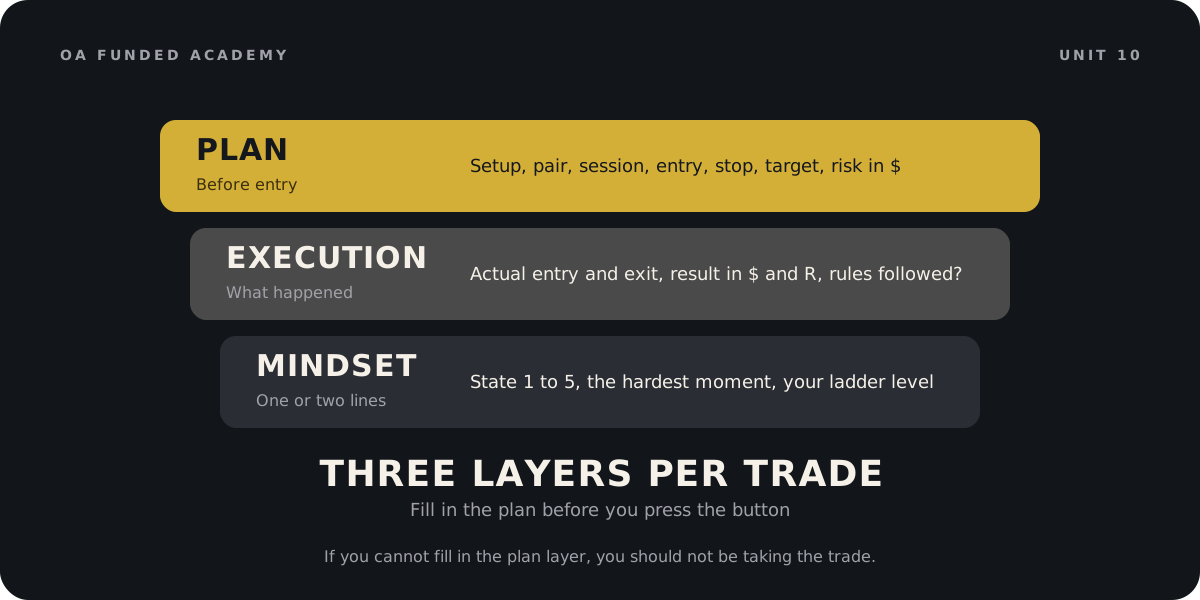
Plan layer: what you intended before entry. Setup name, pair, session, planned entry, stop, target and risk in dollars. Ideally you fill this in before you press the button. If you cannot fill it in, you should not be taking the trade.
Execution layer: what actually happened. Actual entry and exit, result in dollars and in R, any change to the stop or target, and whether every rule was followed. Add one screenshot at entry and one at exit.
Mindset layer: one or two lines. Your state before the session from 1 to 5, what you felt at the hardest moment, and your escalation-ladder level if you use one. Short and specific beats long and vague. "Wanted to close at +0.5R because the last two winners reversed" is useful. "Felt nervous" is not.
Worked example
One complete journal entry
A trader on a $10,000 account risks 0.5% ($50) per trade. Here is one entry from a Tuesday session.
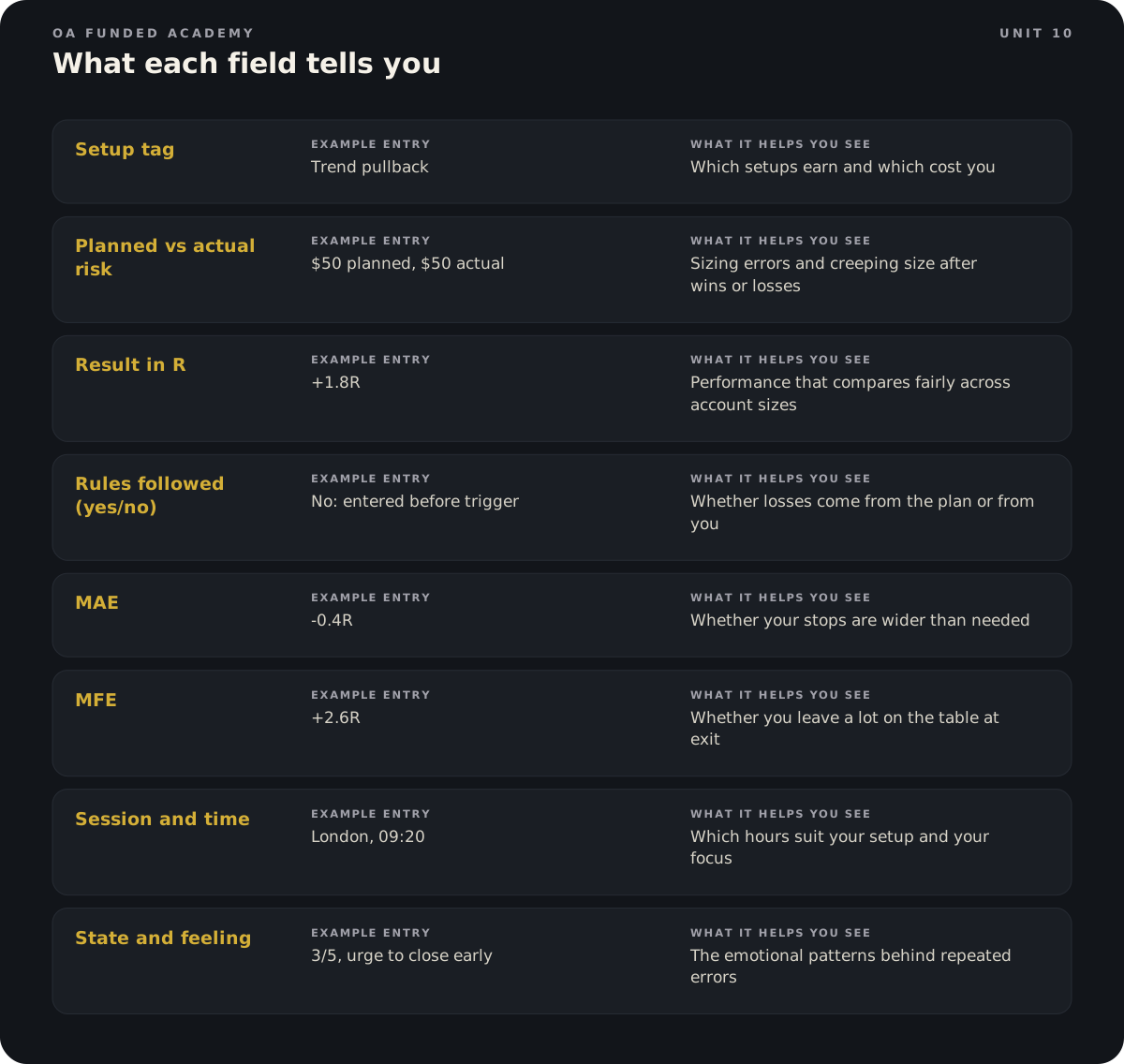
- Plan: EUR/USD trend pullback, London session. Entry 1.0842, stop 1.0818 (24 pips), target 1.0885 (43 pips, 1.8R). Risk $50 at 0.20 lots, rounded down from 0.208 lots, so $48 actual.
- Execution: entered at 1.0843 (1 pip of slippage). Price went down to 1.0833, then up to 1.0880. The trader closed at 1.0865 because it "stalled". Result: +22 pips x $2 = +$44, about +0.9R.
- MAE: 10 pips against, about -0.4R. MFE: 37 pips in favour, about +1.5R.
- Rules followed: no. The exit rule was the 1.8R target, and the trader closed early without a written reason.
- Mindset: state 4/5 before the session. At the stall, felt worried the trade would reverse like Monday's. Ladder: yellow.
- Lesson for the weekly review: a winning trade that broke the exit rule. The plan's target would not have been hit this time, but the early exit was driven by Monday's trade, not by anything on this chart.
Takeaway: On P&L alone this is a +$44 win. With the full record it is a rule break driven by a feeling from yesterday. Only the full record shows you what to work on.
R, MAE and MFE: three numbers worth the effort
R puts every trade on the same scale. If you risk $50 and make $90, that is +1.8R. If you later trade a bigger account and risk $125, a +1.8R trade is still +1.8R. That lets you compare months fairly and spot changes in your trading, not just changes in your size.
MAE, maximum adverse excursion, is the furthest a trade went against you while it was open. MFE, maximum favourable excursion, is the furthest it went in your favour. Some platforms and journal tools record these automatically. If yours does not, note the extreme prices when you close the trade.
Over 20 or more trades, these two numbers answer questions your gut cannot. If your winners almost never go more than 0.5R against you, your stop might be wider than the setup needs. If your trades often reach +2.5R but you close at +1R, your exit is costing you. Do not change anything based on five trades. Wait until the pattern is clear.
Worked example
What 20 trades of MAE and MFE revealed
A trader on a $25,000 account risks 0.4% ($100) per trade. After 20 trades of one setup, they sort the journal.
- Results: 9 winners, 11 losers. Average winner +1.2R ($120), average loser -1.0R ($100). Net: (9 x $120) - (11 x $100) = $1,080 - $1,100 = -$20.
- MFE on the 9 winners averaged +2.3R. They were closing at about half of the move that was available.
- Execution notes: 7 of the 9 winners were closed early by hand, before the written 2R target. All 7 had a mindset note like "didn't want to give it back".
- If the 7 early exits had been held to the 2R target and still reached it (MFE says they went far enough), each would have added about +0.8R. That is roughly +5.6R, about $560, over 20 trades.
- Conclusion: the setup is not the main problem. The exit behaviour is. The one change for next week: no manual exits before the target unless the written invalidation is hit.
Takeaway: The trader nearly scrapped this setup for being flat. The journal showed the problem was in their hands, not in the setup. Past MFE does not promise future moves, but it does point to where to look.
A valid trade follows every rule and loses 1R. How should it go in the journal?
The five-minute daily review
At the end of each session, before you do anything else, answer four questions. Did I follow my plan on every trade? Did I respect my session limits? What was the hardest moment, and what did I do? Is there anything I need to watch for tomorrow?
That is it. Do not analyse the strategy daily. One day of trades is too small a sample to tell you anything about the setup. The daily review is about catching behaviour early, like a rule break on Tuesday that could become a habit by Friday.
If you broke a rule today, write it in one line with the trigger. "Oversized after two losses because I wanted to finish green" is perfect. You will see these lines again on the weekend.
Do the daily review even on days you did not trade. "No valid setups, stayed out" is a good entry. It records that you passed when you should have, and it keeps the habit going on quiet days, which is when most journals quietly die.
If you skipped a day of journaling, do not try to rebuild it from memory a week later. Fill in what the platform history shows, mark the mindset fields as missing, and carry on. A gap is better than a made-up record.
The weekly review: where the real learning happens
Set a fixed time, for example Saturday morning, and give it 30 to 45 minutes. Go through these in order.
First, the numbers: total trades, result in R, win rate, average winner and average loser, and your rule-adherence rate (rule-following trades divided by all trades).
Second, split the results: what did rule-following trades produce, and what did rule-breaking trades produce? This one split answers most "is it me or the strategy?" questions.
Third, the mistakes: count your mistake tags and find the one that cost the most in R. Not the most annoying one. The most expensive one.
Fourth, missed trades: valid setups you skipped, and why. Hesitation after losses often shows up here first.
Finally, pick one change for next week. Make it simple and checkable, like "no manual exits before target" or "15-minute break after every loss". Write it at the top of next week's journal and check it at the next review.
Worked example
A weekly review, start to finish
A trader on a $10,000 account (1R = $50) reviews a week of 12 trades.
- Numbers: 12 trades, net -1.5R (-$75). 5 winners, 7 losers. Adherence: 8 of 12 trades followed every rule, so 67%.
- Split: the 8 rule-following trades made +1.5R (+$75). The 4 rule-breaking trades lost -3.0R (-$150).
- Mistake tags: 3 unplanned trades after a loss (-2.5R), 1 moved stop that turned a planned -1R into a -0.5R loss but broke the management rule. The most expensive is clearly unplanned trades after a loss.
- Missed trades: 2 valid setups skipped on Thursday after a morning loss.
- One change: after any loss, a 15-minute break away from the screen and a written check of the next setup against the plan before entry.
- Not changed: the setup, the stop rule and the target. The rule-following trades gave no reason to touch them yet, and 8 trades is far too few to judge them.
Takeaway: The week lost $75, but the plan made $75 when it was followed. The work is on behaviour after losses, and that is the only thing that changes.
After a losing week, which next step does a good weekly review lead to?
Over 30 trades, rule-following trades are slightly negative and rule-breaking trades are rare. What does the journal suggest?
Avoid these
Common mistakes.
Mistake
Recording only profit and loss
Do this instead
Record the plan, the actual execution and your state, so you can see why the result happened.
Mistake
Building a template so detailed you stop using it
Do this instead
Keep each record under a minute and do the deeper thinking in the weekly review.
Mistake
Writing only feelings with no numbers
Do this instead
Pair each note with times, prices, the rule involved and the result in R.
Mistake
Leaving out embarrassing trades
Do this instead
Log every trade. The worst ones usually explain the results.
Mistake
Changing several rules after one bad week
Do this instead
Pick one change aimed at the most expensive mistake and check it at the next review.
Mistake
Judging the setup without separating rule breaks
Do this instead
Split results into rule-following and rule-breaking trades before you blame the strategy.
Mistake
Ignoring missed trades
Do this instead
Log valid setups you skipped and why. Hesitation patterns often appear there first.
Keep the language straight
Quick glossary.
- Trading journal
- A record of each trade's plan, execution, result and the trader's state at the time.
- R-multiple
- A trade's result divided by the amount risked; risking $50 and making $90 is +1.8R.
- MAE
- Maximum adverse excursion: the furthest a trade moved against you while open.
- MFE
- Maximum favourable excursion: the furthest a trade moved in your favour while open.
- Tag
- A consistent label used to group trades, such as setup, session or mistake type.
- Adherence rate
- The share of trades that followed every rule in your plan.
- Decision quality
- How well a choice followed your process given what you knew at the time, separate from its result.
- Missed trade
- A valid setup under your plan that you did not take.
Lesson check.
6 questions on the whole unit. Score 80% or more to show you have it.
1.You risk $80 per trade (1R) with a 20-pip stop. A trade closes at +30 pips. While it was open, it went 6 pips against you at worst and reached +50 pips at best. What are the result, MAE and MFE in R?
2.Your weekly review covers 15 trades at $50 per R. The 10 rule-following trades made +2.0R in total. The 5 rule-breaking trades lost -4.0R. What do the numbers say?
3.Which mindset note will be most useful when you review it next week?
4.What is the main job of the five-minute daily review?
5.Over 25 trades of one setup, your winners reached an average MFE of +2.4R, but you closed them at an average of +1.1R, mostly by hand before the written target. What does this point to?
6.You missed journaling for a few days and now want to catch up. What is the right approach?
Practice room
3 activitiesTurn the idea into a decision.
These are fictional learning scenarios. They never place trades or use real money. Complete the required checks to finish this lesson.
Finish this unit
Pass each required activity, then save the current lesson version to your record.
Public lesson Q&A
Ask what is still unclear.
No published questions yet.
Sources and review
- Edgewonk: How to Review Your Trading JournalReviewed 2026-10-31Open (opens in a new tab)
- TradesViz: How to Effectively Use a Trading JournalReviewed 2026-10-31Open (opens in a new tab)
- BabyPips: Keep Your Trading Journal AliveReviewed 2026-10-31Open (opens in a new tab)
- BabyPips: Which Trading Journal Tool Should You UseReviewed 2026-10-31Open (opens in a new tab)