

Unit 07 · 38 min read
Building a Complete Trading Plan.
Turn a market idea into written rules another careful person could follow, including when to pass, when to stop and how to size from your invalidation.
- Level
- Beginner
- Revision
- mentor-2026-10
- Access
- Public
By the end, you can
- Write a setup, trigger and invalidation in observable terms
- Calculate position size from a written risk budget and a structural stop
- Add no-trade filters for spread, news, fatigue and time of day
- Set personal session limits that sit well inside any account limit
- Build short pre-session and post-session routines
- Decide when a plan should change and when it should be left alone
Why most first plans fail
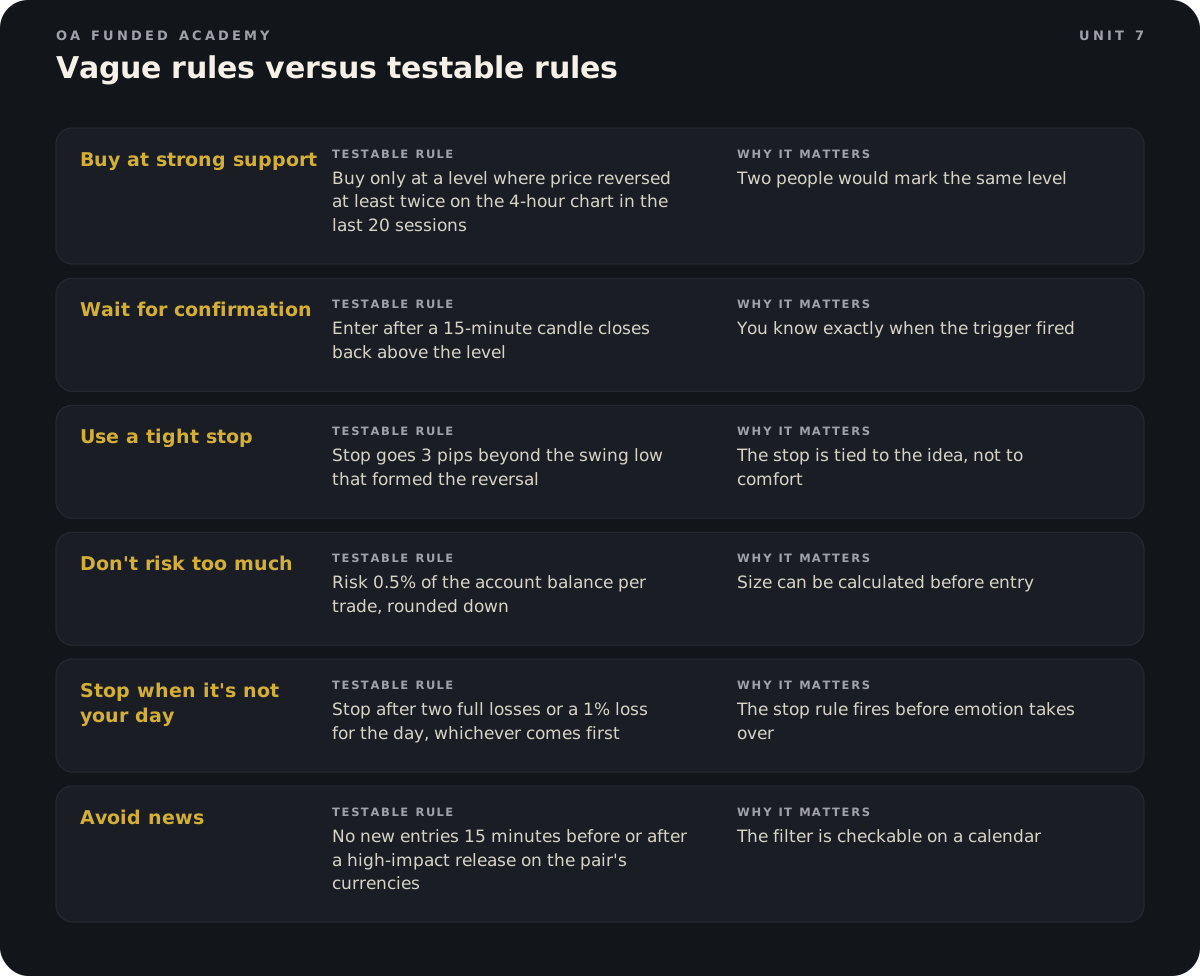
Most newer traders do have a plan. It just lives in their head and changes with their mood. On Monday "support" means the last swing low. On Wednesday, after two losses, it means wherever price happens to be when they feel like buying.
That is not a character flaw. It is what happens when rules are vague. A vague rule leaves room for interpretation, and interpretation is exactly where fear and impatience get in. You enter late because you waited for more proof. You exit early because the candle looked scary. You skip a valid trade because the last one lost.
A complete plan is a decision system. It tells you what you trade, when you trade it, what has to be true before you enter, where you are wrong, how big you go, how you get out, and when you must stop for the day. If you write it well, the live session becomes mostly checking boxes. That is the goal. Boring execution is good execution.
The parts of a complete plan
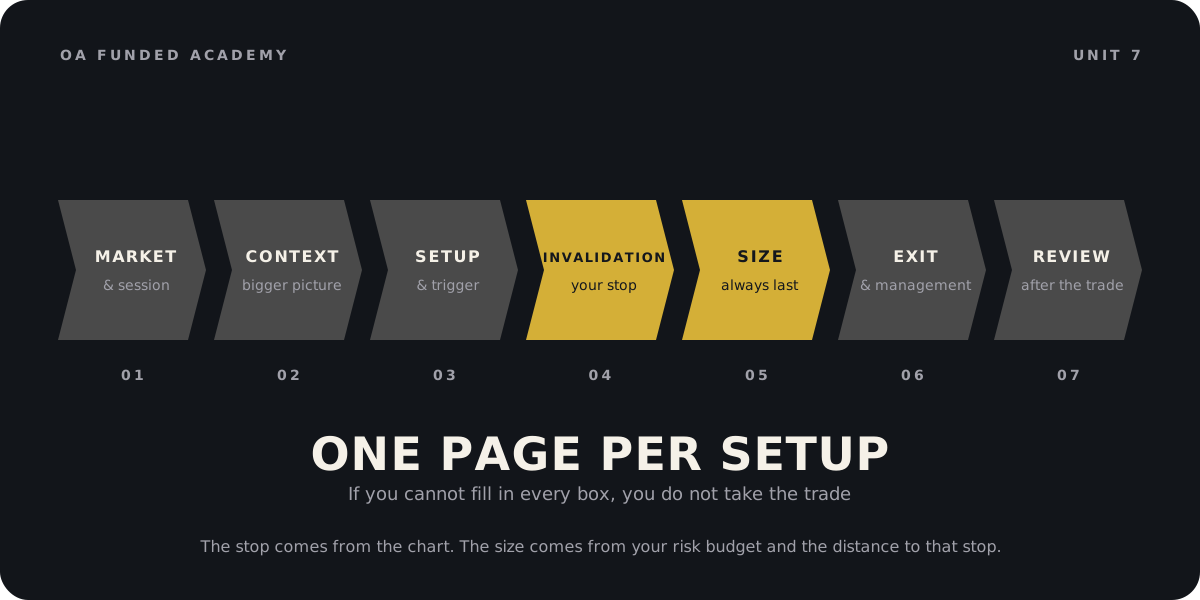
Here is the skeleton I would want you to fill in for every setup you trade. Keep it to one page per setup. If it runs longer, you are probably trading more than one idea.
Market and session: which pairs or indices, and which hours. "EUR/USD and GBP/USD, London open to New York midday" is a rule. "Whatever is moving" is not.
Context: the bigger-picture condition the setup needs. For example, price above the 50-period moving average on the 4-hour chart, or a clear range with at least two touches on each side.
Setup and trigger: the setup is the situation that makes a trade possible. The trigger is the specific event that allows you to press the button. Keep them separate. Many beginners see the setup and jump in before the trigger, then wonder why their entries are early.
Invalidation: the price where the idea is clearly wrong. This becomes your stop. It comes from the chart, not from how much you want to lose.
Size: calculated from your risk budget and the distance to invalidation. Always last before the ticket.
Management and exit: where you take profit, whether you move the stop, and what you do if the session ends with the trade open. Decide this before entry, because after entry you are biased.
Filters and limits: conditions that cancel an otherwise valid trade, and the daily limits that end your session.
Worked example
One setup, written in full
A trader on a $10,000 account wants to trade pullbacks in a trend on EUR/USD. Here is how the idea becomes rules.
- Market and session: EUR/USD only, from the London open until 12:00 New York time.
- Context: the 4-hour chart has made a higher high and a higher low, and price is above the 50-period moving average.
- Setup: price pulls back into the zone of the last 4-hour higher low.
- Trigger: a 15-minute candle closes back above the high of the previous 15-minute candle inside that zone.
- Invalidation: 3 pips below the lowest point of the pullback. Today that is 24 pips from the planned entry.
- Risk: 0.5% of $10,000, which is $50.
- Exit: take profit at the most recent 4-hour high. If that target is less than 1.5 times the stop distance (36 pips here), skip the trade.
- Management: no stop moves until price has travelled 1R (24 pips) in favour, then the stop moves to breakeven. No other changes.
Takeaway: Every line can be checked on a chart or a calculator. If a friend read this page, they would take the same trade you did, or pass on the same one.
Which of these entry rules would two careful traders apply the same way?
Worked example
Sizing from invalidation, not the other way round
Same $10,000 account, 0.5% risk per trade ($50). The structural stop is 24 pips away on EUR/USD, where one standard lot is worth about $10 per pip.
- Start with the stop the chart gives you: 24 pips.
- Divide the risk budget by the stop: $50 / 24 pips = $2.08 per pip.
- Convert to lots: $2.08 / $10 per pip per lot = 0.208 lots.
- Round down to 0.20 lots. Actual risk is 24 x $2.00 = $48.
- Compare a trader who decided on 0.50 lots first and then squeezed the stop to 10 pips to keep risk at $50. That stop sits inside normal noise and is likely to be hit before the idea has a chance to play out.
- If the structural stop had been 60 pips, the same method gives $50 / 60 = $0.83 per pip, or 0.08 lots. Wider stop, smaller size, same dollar risk.
Takeaway: The chart decides the stop. The risk budget decides the dollars. Size is just the arithmetic that connects them.
Session limits: the rules most beginners skip
Ask newer traders for their plan and you usually get entry rules. Ask when they stop for the day and you get a shrug. Yet most blown accounts are not lost on one trade. They are lost on the third and fourth trade of a bad afternoon.
Write three limits. A daily loss stop in dollars. A maximum number of trades. A loss-count stop, such as two full losses in a row. Whichever fires first ends the session. Not "slows you down". Ends it.
If your account has its own loss limit, your personal stop should sit well inside it. On OA Funded, for example, the daily loss floor is set each trading day at the higher of your balance and equity minus 5% of your initial balance. On a $10,000 account starting the day at $10,200, that floor is $9,700. A personal daily stop of 1% ($100 on that account) means you stop long before the account limit is even in view. The account limit is the wall. Your personal limit is the guard rail in front of it.
Worked example
Building daily limits on a $25K account
A trader on a $25,000 account risks 0.4% per trade, which is $100. They want daily limits that stop a bad day early.
- Loss-count stop: two full losses in a row. That is a $200 day at most from normal trades.
- Daily loss stop: 1% of the balance, $250. This catches days where small losses and slippage add up.
- Maximum trades: four per session, win or lose.
- Worst normal day: two losses and done, so roughly -$200, or 0.8% of the account.
- Without limits, the same trader who doubles size after two losses risks $200 on trade three. Lose that and the day is -$400. Double again and it is -$800, more than three times the planned worst case.
Takeaway: Limits only work if they are written before the session and treated as final. A limit you renegotiate in the moment is not a limit.
You hit your two-loss stop at 10:15. At 10:40 your exact setup appears. What does a complete plan say?
Routines before and after the session
A plan is only useful if you read it when it matters. Build two short routines and treat them as part of the trade.
Before the session, take ten minutes. Check the economic calendar and write down any release times that fall inside your filter. Mark your levels on the higher timeframe. Note your daily stop in dollars on a sticky note. Rate your state from 1 to 5. If you are a 1 or 2 (exhausted, upset, rushed), trade smaller or do not trade.
After the session, take another ten. Screenshot each trade. Mark whether every rule was followed. Write one sentence on what you felt at the hardest moment. Then close the platform. Do not start a second session to fix the first one.
The post-session routine feeds your journal, which you will build properly in the journaling unit. For now, the point is that the session has a start and an end you decided in advance.
When the plan itself should change
Here is the opposite trap. After three losing days, many traders tear up the plan and start again with a new indicator. Three days is not evidence. A setup that wins 45% of the time will regularly lose four or five in a row by chance alone.
Set a review point by sample size, not by mood. After 20 to 30 trades taken under the plan, look at the results. Separate trades where you followed every rule from trades where you did not. If the rule-following trades are performing badly, change one thing and run another sample. If the rule-breaking trades are the problem, the plan is fine and the work is on execution.
Keep old versions. Date every version of your plan. When you look back in six months, you will want to know which rules produced which results.
After 25 trades, your rule-following trades are slightly positive and your rule-breaking trades lost most of the money. What should you change?
Avoid these
Common mistakes.
Mistake
Planning only the perfect trade
Do this instead
Add pass conditions for spread, news, fatigue and losing streaks. Most of your trading decisions will be passes.
Mistake
Picking a lot size first and fitting the stop to it
Do this instead
Find the structural stop on the chart, then calculate size from your dollar risk.
Mistake
Writing entry rules but no session limits
Do this instead
Write a loss-count stop, a daily dollar stop and a maximum number of trades. Whichever fires first ends the session.
Mistake
Moving the stop or target mid-trade because it feels right
Do this instead
Decide management before entry. Log any urge to change it and review it at your scheduled checkpoint.
Mistake
Rewriting the plan after a few losing days
Do this instead
Review by sample size, usually 20 to 30 trades, and separate rule-following trades from rule breaks before judging the plan.
Mistake
Mixing several setups into one vague plan
Do this instead
One page per setup. If you trade two ideas, write two pages so you can measure each one.
Mistake
Keeping the plan only in your head
Do this instead
Write it down, date it and keep it open on screen during the session.
Keep the language straight
Quick glossary.
- Trading plan
- A written set of rules covering what you trade, when, how you enter, size, manage and exit, and when you stop.
- Setup
- A repeatable market situation that makes a trade possible.
- Trigger
- The specific event that permits entry once a setup is present.
- Invalidation
- The price or event that shows the trade idea is wrong; your stop is placed from it.
- Filter
- A condition that cancels an otherwise valid setup, such as a wide spread or an upcoming release.
- R
- The amount risked on a trade. A $50 risk is 1R, so a $100 gain is +2R.
- Session limit
- A pre-set rule, such as a daily loss stop or trade cap, that ends the trading session.
- Pip value
- The dollar change in a position for a one-pip move; about $10 per standard lot on EUR/USD.
Lesson check.
6 questions on the whole unit. Score 80% or more to show you have it.
1.A trader on a $20,000 account risks 0.5% per trade. The structural stop on EUR/USD is 32 pips away, and one standard lot is worth about $10 per pip. What position size does the plan give, rounded down?
2.Your plan says: skip the trade if the target is less than 1.5 times the stop distance. Today the structural stop is 30 pips and the nearest sensible target is 40 pips away. What does the plan say?
3.What is the best description of the difference between a setup and a trigger?
4.A trader on a $15,000 account risks $60 per trade and has three written limits: stop after two losses in a row, stop at a $150 daily loss, and a maximum of four trades. Today's trades so far: +$120, then -$60, then -$60. What does the plan say now?
5.A trader picks 1.00 lot because it feels right, then places the stop 5 pips away so the dollar risk stays at $50. What is the core problem?
6.Your setup historically wins about 45% of the time. It has lost four trades in a row over three days. What is the right response?
Practice room
3 activitiesTurn the idea into a decision.
These are fictional learning scenarios. They never place trades or use real money. Complete the required checks to finish this lesson.
Finish this unit
Pass each required activity, then save the current lesson version to your record.
Public lesson Q&A
Ask what is still unclear.
No published questions yet.
Sources and review
- BabyPips School of Pipsology: What Is a Trading PlanReviewed 2026-10-31Open (opens in a new tab)
- BabyPips: Sticking to Your Trading PlanReviewed 2026-10-31Open (opens in a new tab)
- FXStreet: Five common forex trading mistakes and how to avoid themReviewed 2026-10-31Open (opens in a new tab)
- TradeZella: How to Stop Revenge Trading (daily limits and loss-count stops)Reviewed 2026-10-31Open (opens in a new tab)