

Unit 08 · 36 min read
Discipline and Trading Psychology.
Recognise emotional escalation early and put practical barriers between an impulse and the order ticket, so your plan still runs on your worst days.
- Level
- Beginner
- Revision
- mentor-2026-10
- Access
- Public
By the end, you can
- Name the common emotional patterns and the urges they create
- Calculate what an escalation spiral costs compared with a planned stop
- Build a personal escalation ladder with a fixed action at each level
- Score your sessions on process as well as profit and loss
- Use a recovery routine after a loss, a big win or a broken rule
Emotion is information, not instruction
You will feel things while you trade. Fear when a position goes red. A tight chest when price runs without you. A hot, urgent feeling after a stop-out, like the market owes you one. Every trader feels these. The ones who last are not the ones who stopped feeling. They are the ones who notice the feeling early and already know what they will do about it.
Think of an emotion as a dashboard light. It tells you something is happening. It does not tell you to press the buy button. The skill this unit teaches is simple to say and hard to do: notice the state, name it, rate it, and follow the response you wrote down when you were calm.
Brett Steenbarger, a psychologist who has worked with professional traders for years, describes revenge trading as attention pointed backwards. Your focus is on the loss you just took, not on the chart in front of you. That framing helps, because it tells you what to fix. You do not need to feel better. You need to get your attention back on the present market, or get away from the screen until you can.
The patterns that hurt newer traders most
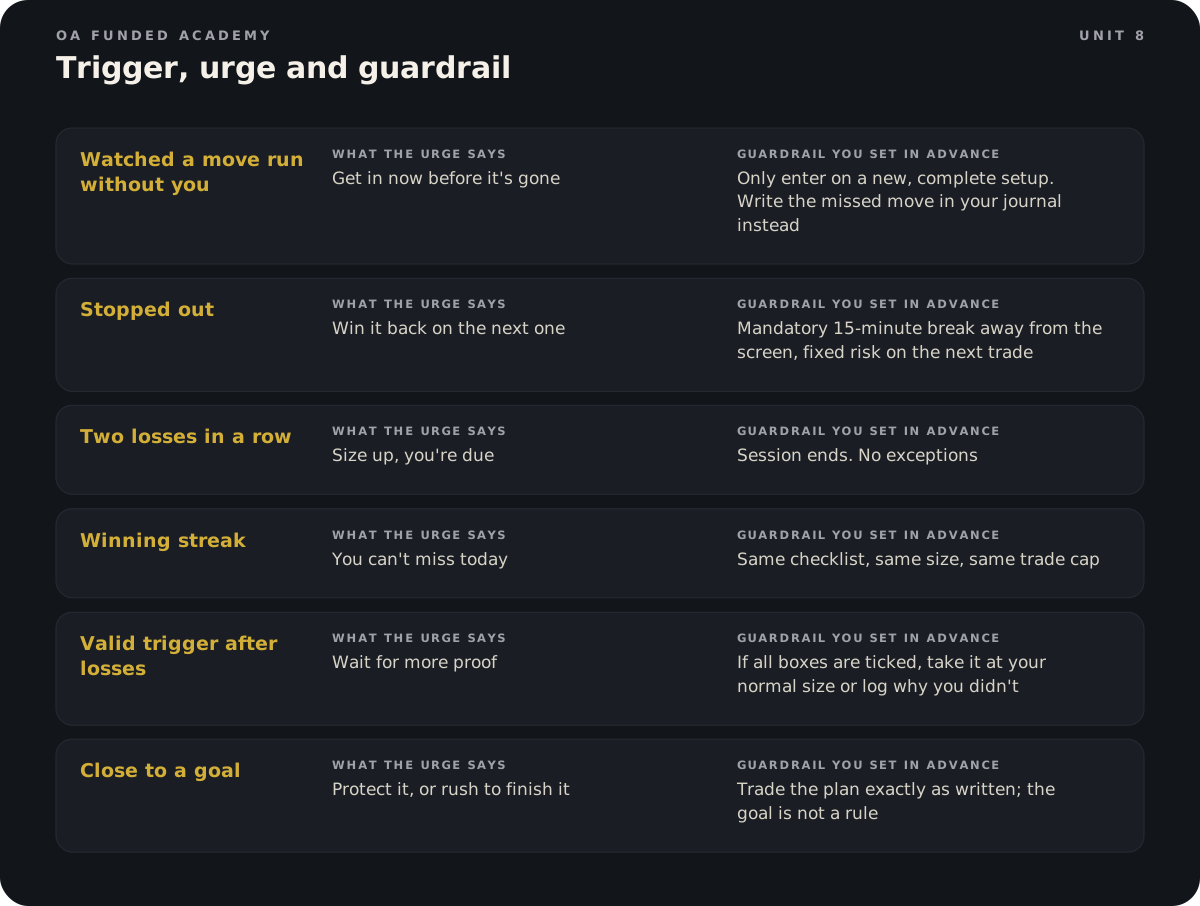
FOMO. You watch a pair run 40 pips while you were waiting for your trigger. Now it feels like the train is leaving. You jump in near the top, with a stop that makes no structural sense. As Steenbarger puts it, you are always going to miss opportunities. A missed trade costs nothing. A chased one often costs a full loss.
Revenge. You get stopped out and immediately look for the next entry, usually bigger, usually outside your plan. The goal has quietly changed from "trade my setup well" to "get my money back".
Hesitate, then chase. After a few losses you stop trusting your setup. A valid trigger fires and you freeze. Price moves without you, it works, and you chase it at a worse price. You end up taking the trade at the worst moment, with the least edge.
Overconfidence. Five wins in a row and every chart starts to look obvious. You skip the checklist, add a second position, or size up. Many traders give back a good week in one careless afternoon.
Goal pressure. Close to a target, whether a weekly goal or a profit target, traders either freeze and stop taking valid trades, or force trades to get it over with. Both mean the number is now making your decisions instead of your plan.
Worked example
What a revenge spiral actually costs
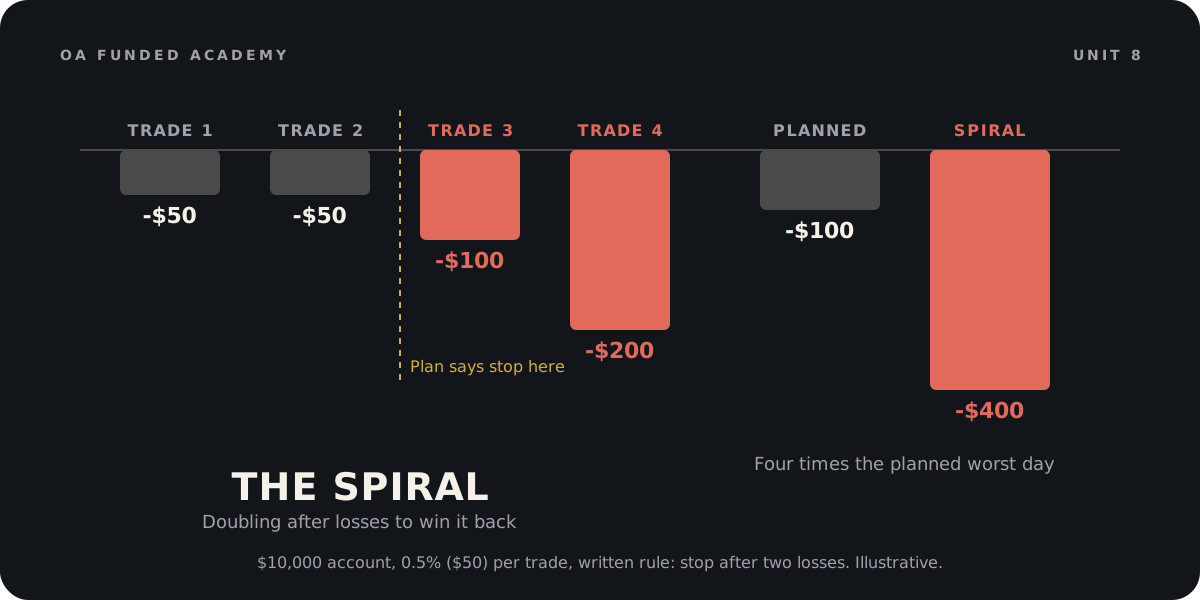
A trader on a $10,000 account risks 0.5% ($50) per trade and has a written rule: stop after two losses. Today they ignore it.
- Trade 1 loses: -$50. Balance $9,950.
- Trade 2 loses: -$50. Balance $9,900. The plan says the session is over at -$100.
- Trade 3: frustrated, they double to $100 risk to win it back fast. It loses: -$100. Balance $9,800.
- Trade 4: they double again to $200. It loses: -$200. Balance $9,600.
- Total for the day: -$400, four times the planned worst case of -$100.
- To recover $400 at their normal $50 risk, they now need eight trades that each make a full 1R, or four that each make 2R, on top of whatever losses come along the way.
Takeaway: A loss of $100 is a normal day. A loss of $400 is a hole that can take weeks to climb out of. The rule that ends the session is cheaper than any recovery plan.
You just took an unplanned loss and feel an urgent need to get back in. What is the best immediate step?
Build an escalation ladder
An escalation ladder is a short list of warning signs at four levels, each with one fixed action. You write it once, when calm, and keep it next to your screen. In the moment you do not decide. You read the level and do what it says.
Green: calm, following the checklist, no urge to trade outside the plan. Action: trade normally.
Yellow: early signs. You are checking P&L more often, you feel a little rushed, you caught yourself looking at a pair that is not on your list. Action: stand up, take five slow breaths, reread your plan before the next trade.
Orange: you are bending rules. You entered before the trigger, widened a stop, or want to size up. Action: no new trades for 30 minutes. Close the order ticket. Write one paragraph on what you are feeling.
Red: you broke a rule you would never break when calm, or you hit your daily stop. Action: session over. Close the platform. Do something physical. Fill in the journal later, not now.
Use your own signs. Some traders notice their jaw clenching. Others notice they start talking to the screen. The more specific the sign, the earlier you will catch it.
Worked example
The ladder in a real session
A trader on a $25,000 account risks 0.4% ($100) per trade. Their ladder is taped to the monitor.
- 09:30, green. Takes a valid trade. It loses: -$100.
- 09:35, yellow sign: they have refreshed the P&L three times in five minutes. They stand up, breathe, reread the plan.
- 10:10, a valid setup appears. They take it at normal size, $100 risk. It hits the target at 2R: +$200. Day: +$100.
- 10:25, orange sign: they want to add a second position on the same pair because "it's running". There is no rule for adding. They close the ticket and take 30 minutes away.
- 11:00, back at green. No valid setups before the session ends. They finish the day at +$100.
- Without the ladder, the 10:25 add-on would have doubled exposure on a trade with no plan for it. A reversal there could have turned a +$100 day into a loss.
Takeaway: The ladder did not make the trader feel calm. It gave them a pre-made action at each level, so feelings never reached the order ticket.
Score the process, not just the money
If profit and loss is the only scoreboard, your mood will follow the last trade. A lucky win teaches you that breaking rules works. A valid loss teaches you that your setup is broken. Both lessons are wrong.
Keep a second score: process. After each trade, give yourself one point for each of these: you took a valid setup, you sized correctly, you placed the stop at invalidation, you followed your management rule, and you respected your session limits. Five points is a perfect trade, whatever the result.
Steenbarger suggests swapping an outcome standard for a process standard. A good trade is one that was executed correctly. Over a meaningful sample, good process is what gives any edge you have a chance to show up. Over a single day, results are mostly noise.
Worked example
Two weeks, two scorecards
A trader on a $25,000 account compares two weeks.
- Week A: +$300. Ten trades, but four broke rules (two chased entries, one oversized trade, one moved stop). Process score: 60%. One oversized trade happened to win $350, which made the whole week.
- Week B: -$150. Eight trades, all valid, all sized correctly, all limits respected. Process score: 100%. Three losses and five small mixed results.
- Week A looks better on the money scoreboard. But its profit came from a rule break that will eventually produce a large loss.
- Week B is the week you want to repeat. Its loss is within normal variation for a valid setup.
Takeaway: Judge the week you can repeat, not the week you happened to like. Process is in your control. The next result is not.
Which statement about Week A and Week B is most accurate?
Recovery routines for the three hard moments
After a loss that followed your plan: say it out loud, "valid trade, normal loss". Log it. Take a short break if your ladder says yellow. Continue only if you are back at green and still inside your limits.
After a broken rule, win or lose: stop for at least 30 minutes. Write exactly which rule you broke and what you felt one minute before. Decide whether to continue using your ladder, not your P&L. A winning rule break needs this more than a losing one, because it rewards the wrong habit.
After a big win or a great week: keep the same size and the same trade cap for the next session. Many traders treat a strong week as permission to loosen up. It is not permission. It is a sample of one week.
None of this needs to be perfect. Missing one routine is not a disaster. The aim is that, over a month, the routines run more often than the impulses do.
You oversized a trade against your plan and it made $400. What is the right response?
Avoid these
Common mistakes.
Mistake
Trying to remove emotion completely
Do this instead
Expect emotion. Notice it early and follow a response you wrote when calm.
Mistake
Relying on willpower after a loss
Do this instead
Use structure: a loss-count stop, a trade cap and closing the platform when the ladder hits red.
Mistake
Chasing a move you missed
Do this instead
Log the missed move and wait for a new, complete setup. Missed trades cost nothing.
Mistake
Sizing up after a winning streak
Do this instead
Keep size, checklist and trade cap the same. Change risk only through a scheduled review.
Mistake
Letting a winning rule break slide
Do this instead
Treat it exactly like a losing rule break: pause, log and review the trigger.
Mistake
Judging yourself only by profit and loss
Do this instead
Keep a process score for every trade and review it alongside results.
Mistake
Trading on days you already know are bad
Do this instead
Run a state check before the session and skip the day at 1 or 2 out of 5.
Keep the language straight
Quick glossary.
- FOMO
- Fear of missing out; the urge to enter late because a move is happening without you.
- Revenge trading
- Trading to recover a previous loss rather than because a valid setup exists.
- Tilt
- A state where emotion has taken over and decisions get steadily worse.
- Guardrail
- A rule or physical barrier that limits a harmful action, such as a hard daily stop.
- Escalation ladder
- A written list of warning signs at increasing levels, each with a fixed action.
- Process score
- A score for how well a trade followed the plan, kept separately from its result.
- Overconfidence
- Overestimating your skill after recent wins, often leading to skipped checks or larger size.
Lesson check.
6 questions on the whole unit. Score 80% or more to show you have it.
1.A trader on a $20,000 account risks 0.5% per trade and has a rule to stop after two losses. Today they lose two trades, ignore the rule, double their risk on trade three, double again on trade four, and lose both. What did the day cost compared with the plan?
2.You score every trade on process: one point each for a valid setup, correct size, stop at invalidation, following your management rule, and respecting session limits. This session: trade A scored 5, trade B was oversized and had its stop moved (3), trade C was entered before the trigger (4), trade D scored 5. What is the session's process score?
3.What does it mean to treat emotion as information, not instruction?
4.Halfway through a session you notice you have just widened a stop and you want to size up on the next trade. On the four-level escalation ladder from this unit, what level is this and what is the action?
5.After three losses this week, a valid trigger fires with every box ticked, but you hesitate. Price moves without you and works. What guardrail does the unit suggest for this pattern?
6.Which approach is most likely to stop revenge trading after a loss?
Practice room
3 activitiesTurn the idea into a decision.
These are fictional learning scenarios. They never place trades or use real money. Complete the required checks to finish this lesson.
Finish this unit
Pass each required activity, then save the current lesson version to your record.
Public lesson Q&A
Ask what is still unclear.
No published questions yet.
Sources and review
- TurtleTrader: Brett Steenbarger's Three Vices of TradingReviewed 2026-10-31Open (opens in a new tab)
- SMB Capital: Trading Psychology, How to Handle FOMO (Dr. Steenbarger)Reviewed 2026-10-31Open (opens in a new tab)
- TradeZella: How to Stop Revenge TradingReviewed 2026-10-31Open (opens in a new tab)
- BabyPips: Sticking to Your Trading PlanReviewed 2026-10-31Open (opens in a new tab)