Unit 04 · 38 min read
Forex Mathematics and Trading Costs.
Learn the handful of numbers behind every forex trade: pips, lots, pip value, leverage, margin, spread, commission and swap. By the end you can work out what a trade risks and what it actually made after costs, for EUR/USD and USD/JPY, before you press the button.
- Level
- Beginner
- Revision
- mentor-2026-10
- Access
- Public
By the end, you can
- Define a pip, a pipette, a unit and a lot, and convert between them
- Calculate pip value for EUR/USD and USD/JPY on a US dollar account
- Explain leverage and margin, and calculate the margin a position uses
- Separate margin (collateral) from risk (what the stop can cost)
- List the three main trading costs and where each one shows up
- Calculate the net result of a closed trade from fill prices, commission and swap
Why the maths comes before the chart
I have watched a lot of new traders lose money on trades that were not even bad ideas. The idea was fine. The size was wrong. They typed 1.0 when they meant 0.10, or they copied a lot size from a video made on a much bigger account, or they believed the margin number on the screen was the most they could lose. None of that is a chart problem. It is a maths problem, and the maths is simple once you learn the words.
So this unit is about the words and the numbers. We will go slowly. Every term gets defined before we use it, and every example shows the arithmetic line by line. Keep a calculator next to you and do the sums yourself as you read. Reading the answer is not the same as being able to get it.
Here is the promise I can make: after this unit, you will be able to say in dollars what a trade risks before you enter it, and what it actually made after costs once you close it. I cannot promise the trade will win. Nobody can. But you will never again be surprised by the size of a loss.
Pips, pipettes, units and lots
A currency pair has two currencies. The first is the base currency and the second is the quote currency. The price tells you how much of the quote currency one unit of the base currency costs. EUR/USD at 1.0850 means one euro costs 1.0850 US dollars.
A pip is the standard small step that price moves in. For most pairs, including EUR/USD, one pip is 0.0001, the fourth decimal place. If EUR/USD goes from 1.0850 to 1.0851, it moved one pip. For pairs where the yen is the quote currency, such as USD/JPY, one pip is 0.01, the second decimal place. USD/JPY moving from 150.20 to 150.21 is one pip.
Most platforms show one more digit than that. The extra digit is a pipette, which is one tenth of a pip. So EUR/USD may show 1.08504. The 4 on the end is 4 pipettes, or 0.4 pips. Beginners often count pipettes as pips and get every number ten times too big. Find the fourth decimal (or the second, for yen pairs) and count from there.
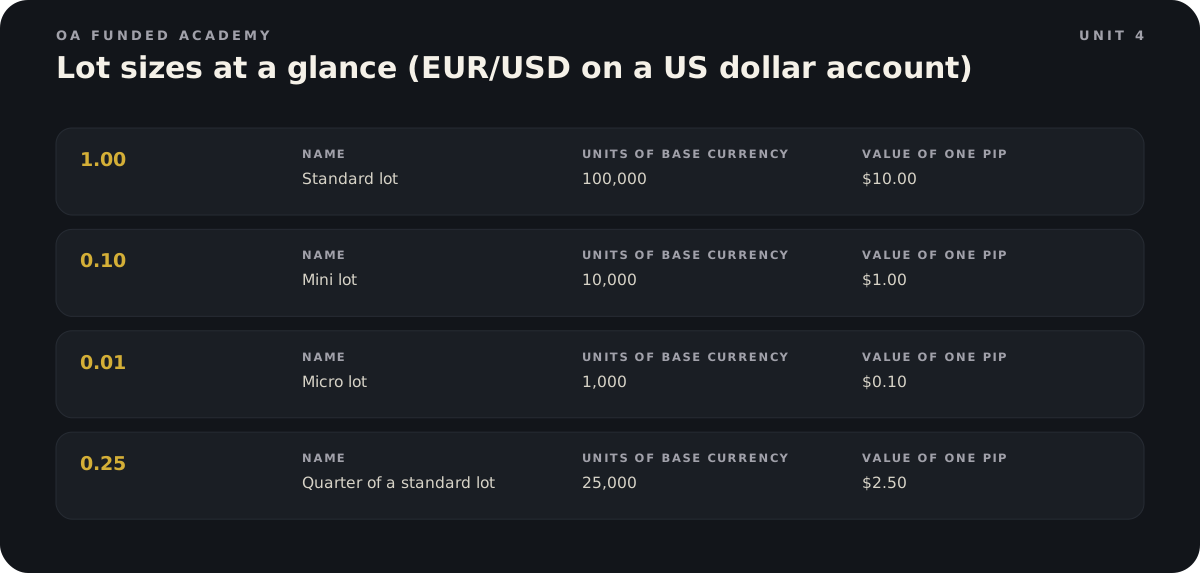
A unit is one unit of the base currency. A lot is a bundle of units. A standard lot is 100,000 units, a mini lot is 10,000 units and a micro lot is 1,000 units. Platforms usually write these as 1.00, 0.10 and 0.01 lots. Some platforms let you enter units directly. Before you trade anywhere, check which one the order ticket is asking for, because typing 1 into a lots box is a hundred times bigger than typing 1 into a units box that expects thousands.
Pip value: what one pip is worth to you
Pip value is how many dollars your position gains or loses when price moves one pip. It depends on three things: the pair, the size of your position, and the currency your account is held in. We will assume a US dollar account throughout.
The basic formula is: pip value in the quote currency = units × pip size. Then, if the quote currency is not your account currency, convert it.
EUR/USD is the easy case. The quote currency is the US dollar, which matches the account. One standard lot is 100,000 units. 100,000 × 0.0001 = $10 per pip. That number does not change as the price moves, which is why EUR/USD is the pair most people learn on.
USD/JPY is the case that catches people. The quote currency is the yen. One standard lot is 100,000 units. 100,000 × 0.01 = 1,000 yen per pip. Your account is in dollars, so divide by the current USD/JPY price. At 150.00, 1,000 ÷ 150.00 = $6.67 per pip. At 140.00 it would be $7.14, and at 160.00 it would be $6.25. The pip value for a yen pair moves a little as the price moves. That is normal. Your platform does this conversion for you, but you should be able to do it on paper so you can catch a wrong number.
Worked example
Pip value and gross profit on EUR/USD ($10K account)
You have a $10,000 account. You buy 0.50 lots of EUR/USD. That is 50,000 euros of exposure. You close the trade 30 pips higher.
- Pip value: 50,000 units × 0.0001 = $5.00 per pip. (Check: half a standard lot, and a standard lot is $10 a pip, so $5 is right.)
- Gross move: 30 pips × $5.00 = $150.00.
- As a share of the account: $150 ÷ $10,000 = 1.5%.
- If the trade had gone 30 pips the other way, the loss would be the same $150. Pip value works in both directions.
Takeaway: Size × pip size gives pip value. Pip value × pips moved gives dollars. Do it in that order every time.
Worked example
Pip value and gross profit on USD/JPY ($25K account)
You have a $25,000 account. You sell 0.30 lots of USD/JPY at 150.20 and buy it back at 149.80. Selling first is called going short: you gain if the price falls.
- Pips moved: 150.20 minus 149.80 = 0.40. For a yen pair one pip is 0.01, so 0.40 ÷ 0.01 = 40 pips in your favour.
- Profit in yen: 30,000 units × 0.40 = 12,000 yen.
- Convert to dollars at the closing price: 12,000 ÷ 149.80 = $80.11.
- Cross-check with pip value: per standard lot, 1,000 yen ÷ 149.80 = $6.68 a pip. For 0.30 lots that is about $2.00 a pip. 40 pips × $2.00 = $80. Same answer, rounded.
- As a share of the account: $80.11 ÷ $25,000 = 0.32%.
Takeaway: Yen pips are the second decimal, and the profit arrives in yen. Convert it back to dollars at the current rate before you judge the trade.
You buy 2.00 lots of EUR/USD on a US dollar account and set a stop 15 pips away. If the stop is hit at exactly that price, roughly how much do you lose before costs?
Leverage and margin, defined properly
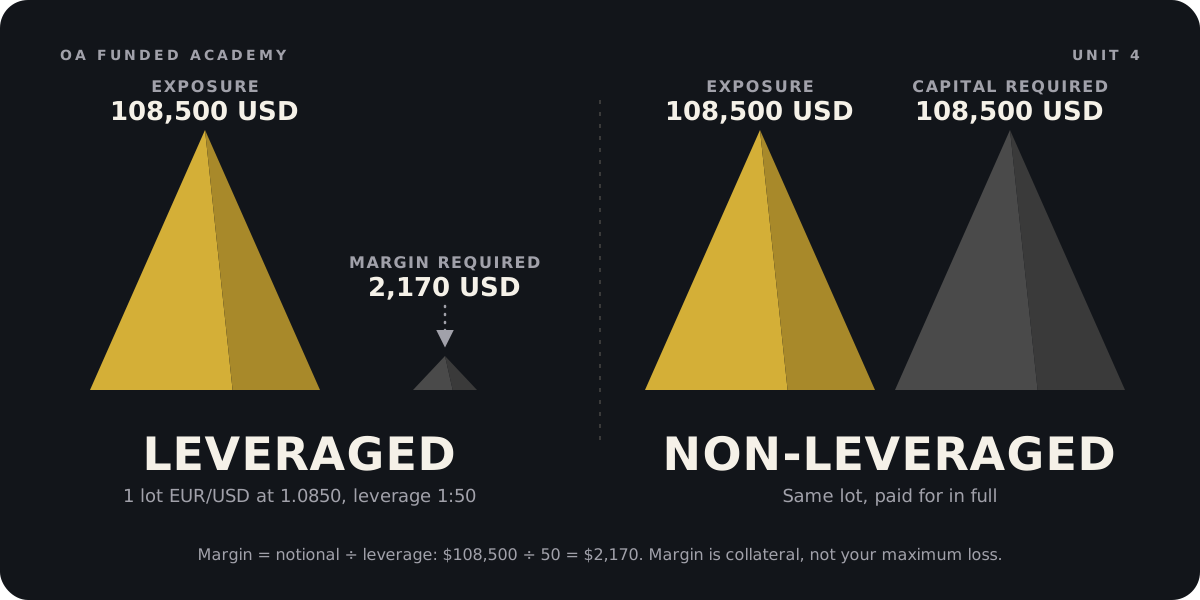
Notional value is the full size of your position in money. One standard lot of EUR/USD at 1.0850 is 100,000 euros, which is 100,000 × 1.0850 = $108,500 of notional value. Very few traders have $108,500 in the account. That is where leverage comes in.
Leverage lets you control a position bigger than the money you put up. It is written as a ratio, like 1:30 or 1:50. At 1:50, every $1 of your money supports up to $50 of position. The money that is set aside to support the position is called margin. Margin is not a fee and it is not spent. It is collateral: a deposit the platform holds while the trade is open and releases when you close it.
The formula is: margin required = notional value ÷ leverage. One standard lot of EUR/USD at 1.0850 with 1:50 leverage needs $108,500 ÷ 50 = $2,170 of margin. At 1:30 the same lot would need $108,500 ÷ 30 = $3,616.67. Same position, same risk, different collateral.
Free margin is the equity you have left after margin is set aside. Equity is your balance plus or minus the profit or loss on open trades. If equity falls too close to the margin in use, the platform can close positions for you. That is called a margin call or stop out, and the exact level depends on the platform.
On OA Funded, leverage is up to 1:50, depending on the instrument. Other providers set their own figures. Always check the instrument before you calculate.
Worked example
Same leverage, very different risk ($10K account)
You have $10,000. EUR/USD is at 1.0850. Leverage on the pair is 1:50. You are deciding between 1.00 lot and 0.20 lots, each with a 40-pip stop.
- 1.00 lot: notional $108,500. Margin $108,500 ÷ 50 = $2,170. Free margin left: $10,000 minus $2,170 = $7,830. That looks comfortable.
- But the risk is $10 a pip × 40 pips = $400, which is 4% of the account on one trade. Five such losses in a row would cost $2,000, a fifth of the account.
- 0.20 lots: notional $21,700. Margin $21,700 ÷ 50 = $434. Risk is $2 a pip × 40 pips = $80, which is 0.8% of the account.
- Effective leverage tells the real story. It is notional ÷ equity. For 1.00 lot: $108,500 ÷ $10,000 = 10.85 times your money. For 0.20 lots: $21,700 ÷ $10,000 = 2.17 times. The screen's leverage setting was 1:50 in both cases.
Takeaway: The leverage setting is a ceiling. What matters is how much of it you use, and that is decided by your lot size.
The three costs: spread, commission and swap
Every trade has a gross result, which is just the price movement times pip value. What lands in your account is the net result, which is the gross result minus costs. There are three costs to learn.
Spread. Every pair has two prices. The bid is the price you can sell at. The ask is the price you can buy at. The ask is always a little higher. The gap is the spread. If EUR/USD is 1.08500 bid and 1.08508 ask, the spread is 0.8 pips. You pay it by buying at the higher price and selling at the lower one. That means a new trade starts slightly in the red. Spreads are usually tight in busy hours and can widen sharply around news releases, at the daily rollover and when markets are thin.
Commission. Some accounts charge a fee per trade on top of the spread, usually quoted per lot. It may be charged when you open, when you close, or both (called round turn). Commission is paid whether the trade wins or loses. The figures in this unit are made-up examples for practice, not any provider's actual price. Look up your own.
Swap. If you hold a position past the provider's daily cut-off, a financing adjustment is applied. This is called swap or rollover. It comes from the interest rate difference between the two currencies, plus the provider's own terms. It can be a cost or, sometimes, a small credit, and many providers apply a larger charge on one day of the week to cover the weekend. Intraday traders who close before the cut-off usually pay no swap.
Slippage is not a fee, but it acts like one. It is the gap between the price you expected and the price you got. Stops fill at the next available price, so in a fast market a 20-pip stop can fill at 23 pips. Allow for it.
Worked example
Net result of a real-looking EUR/USD trade ($10K account)
Same $10,000 account. You buy 0.50 lots of EUR/USD when the quote is 1.08500 bid / 1.08508 ask. You hold overnight and close the next day when the quote is 1.08800 bid / 1.08808 ask. For practice, assume a commission of $7 per standard lot round turn and a swap charge of $1.20 for the night. These are example figures only.
- Your buy fills at the ask: 1.08508. Your sell to close fills at the bid: 1.08800.
- Pips captured: 1.08800 minus 1.08508 = 0.00292, which is 29.2 pips. The bid moved a full 30 pips, but you paid 0.8 pips of spread getting in.
- Gross result from your fills: 29.2 pips × $5.00 = $146.00. The spread is already inside this number because it came from your actual fill prices.
- Commission: 0.50 lots × $7 = $3.50.
- Swap: one night at $1.20.
- Net result: $146.00 minus $3.50 minus $1.20 = $141.30. That is 1.41% of the account, against the 1.5% you might have expected from the chart.
Takeaway: Net = gross from your fill prices, minus commission, minus swap (or plus, if swap is a credit). Do not subtract the spread a second time if your gross already uses fill prices.
Worked example
Costs on a small target hurt more ($25K account, USD/JPY)
Back to the $25,000 account and the 0.30-lot USD/JPY short from earlier, which made $80.11 gross from fill prices. Same practice commission of $7 per lot round turn. Closed the same day, so no swap. Now compare it with a scalp: same size, only 8 pips captured.
- 40-pip trade: commission 0.30 × $7 = $2.10. Net: $80.11 minus $2.10 = $78.01. Costs took 2.6% of the gross.
- 8-pip trade: gross is 8 × $2.00 = about $16.02. Commission is still $2.10. Net: $13.92. Costs took 13% of the gross.
- Now add the spread you paid on entry, say 1 pip, which is about $2.00. On the 8-pip trade that 1 pip was an eighth of the whole move.
- If you placed the 8-pip trade ten times a day, commission alone would be $21 a day before a single win or loss.
Takeaway: Costs are roughly fixed per trade, so the smaller your targets, the bigger the share that costs eat. Short-term styles have to beat a higher cost hurdle.
Your platform shows a closed trade made $80 from your fill prices. You paid $7 commission and $3 swap. What is the net result?
A trade uses $434 of margin and has a 40-pip stop at $2 a pip. What is the planned loss if the stop fills exactly?
Avoid these
Common mistakes.
Mistake
Copying a lot size from someone else's trade or video
Do this instead
Their account, stop and pip value are not yours. Calculate your own size from your own stop distance and the dollars you are willing to lose.
Mistake
Counting the pipette digit as a full pip
Do this instead
Find the fourth decimal on most pairs, or the second decimal on yen pairs. The extra digit after that is tenths of a pip.
Mistake
Treating margin as the maximum you can lose
Do this instead
Margin is collateral. Your loss is pip value times pips moved, and it can be far larger than the margin if there is no stop.
Mistake
Calling leverage free buying power
Do this instead
Leverage amplifies both gains and losses on the money you have. Use the leverage setting as a ceiling, not a target.
Mistake
Using EUR/USD pip value ($10 a lot) for USD/JPY
Do this instead
Yen pairs give pip value in yen. Divide 1,000 yen by the current USD/JPY price to get dollars per standard lot, about $6.67 at 150.00.
Mistake
Judging a trade on gross profit
Do this instead
Subtract commission and swap from the result based on your fill prices. Small-target trades in particular can look profitable gross and thin out net.
Mistake
Subtracting the spread twice
Do this instead
If your gross result came from actual fill prices, the spread is already paid inside it. Only subtract it separately if you measured from mid or bid-only prices.
Mistake
Entering an order without reading the size box back
Do this instead
Read the size digit by digit and check whether the box wants lots or units before every order.
Keep the language straight
Quick glossary.
- Base currency
- The first currency in a pair. One unit of it is what the price is quoting.
- Quote currency
- The second currency in a pair. The price is how much of it one unit of the base costs.
- Pip
- The standard price step: 0.0001 for most pairs, 0.01 for pairs quoted in yen.
- Pipette
- One tenth of a pip, shown as the extra last digit on most platforms.
- Lot
- A bundle of units. Standard = 100,000, mini = 10,000, micro = 1,000 units of the base currency.
- Pip value
- How much money the position gains or loses for a one-pip move, in your account currency.
- Notional value
- The full size of a position in money, before leverage.
- Leverage
- A ratio that lets you control a position larger than the collateral you put up, such as 1:50.
- Margin
- Collateral held while a leveraged position is open. Released when you close. Not a fee and not your maximum loss.
- Equity
- Your balance plus or minus the profit or loss on open positions.
- Spread
- The gap between the ask (buy) price and the bid (sell) price.
- Commission
- A fee per trade, usually quoted per lot, charged on some accounts on top of the spread.
- Swap (rollover)
- A financing adjustment applied when a position is held past the provider's daily cut-off.
- Slippage
- The difference between the price you expected and the price you were filled at.
Lesson check.
6 questions on the whole unit. Score 80% or more to show you have it.
1.Your platform shows EUR/USD move from 1.08500 to 1.08537. How many pips is that?
2.On a US dollar account you hold 0.40 lots of USD/JPY at 160.00. Price moves 25 pips in your favour. Roughly what is that worth in dollars?
3.You open 0.50 lots of EUR/USD at 1.1000 with 1:50 leverage. How much margin does it use, and what does that number mean?
4.Which statement about leverage is accurate?
5.You buy 0.30 lots of EUR/USD when the quote is 1.08504 bid / 1.08512 ask, and close when it is 1.08812 bid / 1.08820 ask. Practice commission is $7 per lot round turn, and swap for the night is $0.90. What is the net result?
6.Why do styles with very small targets face a bigger cost hurdle?
Practice room
3 activitiesTurn the idea into a decision.
These are fictional learning scenarios. They never place trades or use real money. Complete the required checks to finish this lesson.
Position-size sandbox
Cash risk
$50.00
Position size
0.25 lots
Learning estimate only. Verify contract size, quote-currency conversion and costs in the instrument specification before any order.
Finish this unit
Pass each required activity, then save the current lesson version to your record.
Public lesson Q&A
Ask what is still unclear.
No published questions yet.
Sources and review
- Babypips: What Is a Pip in Forex? Pips and Pipettes ExplainedReviewed 2026-10-31Open (opens in a new tab)
- Babypips: Lot Size in Forex (Standard, Mini, Micro and Nano)Reviewed 2026-10-31Open (opens in a new tab)
- Investopedia: Understanding Forex Rollover RatesReviewed 2026-10-31Open (opens in a new tab)
- Reddit r/Forex: Just blew my account by mistyping a lot sizeReviewed 2026-10-31Open (opens in a new tab)
- OA Funded Trading Rules (leverage)Reviewed 2026-10-31Open (opens in a new tab)